Underlayment Calculator: Rolls and Seam Tape
Enter the floor size and the coverage on the roll. Vapor barrier film is overlapped at the seams, so we work out how much of each roll you actually use.
Your estimate
Buy 2 rolls
foam · 100 sq ft per roll
- Floor area
- 180 sq ft
- Usable per roll
- 100 sq ftbutt joints
- Waste
- 5%
- Seam tape
- 60 ft of seams · 1 roll
Add a price per roll to see the cost.
How we got this: 180 sq ft × 1.05 ÷ 100 sq ft usable per roll = 1.89, rounded up to 2 rolls.
Run underlayment strips across the direction of the planks, so seams in the two layers do not line up.
How the calculation works
- Usable coverage. Foam is laid edge to edge, so you use the whole roll. Film is overlapped, usually by 8 in (200 mm), so a 3 ft roll only covers 2 ft 4 in of new floor per strip.
- Rolls. Floor area plus 5% for trimming at the walls, divided by the usable coverage, rounded up.
- Tape. Every seam gets taped. The seam length is the floor area divided by the usable strip width.
Imperial example: 180 sq ft of foam from 100 sq ft rolls needs 2 rolls and 60 ft of tape. The same floor in overlapped film needs 3 rolls, because each roll covers only about 78 sq ft.
Metric example: 20 m² of foam with a vapor barrier from 10 m² rolls needs 3 rolls and a 50 m roll of tape.
Guides to save and share
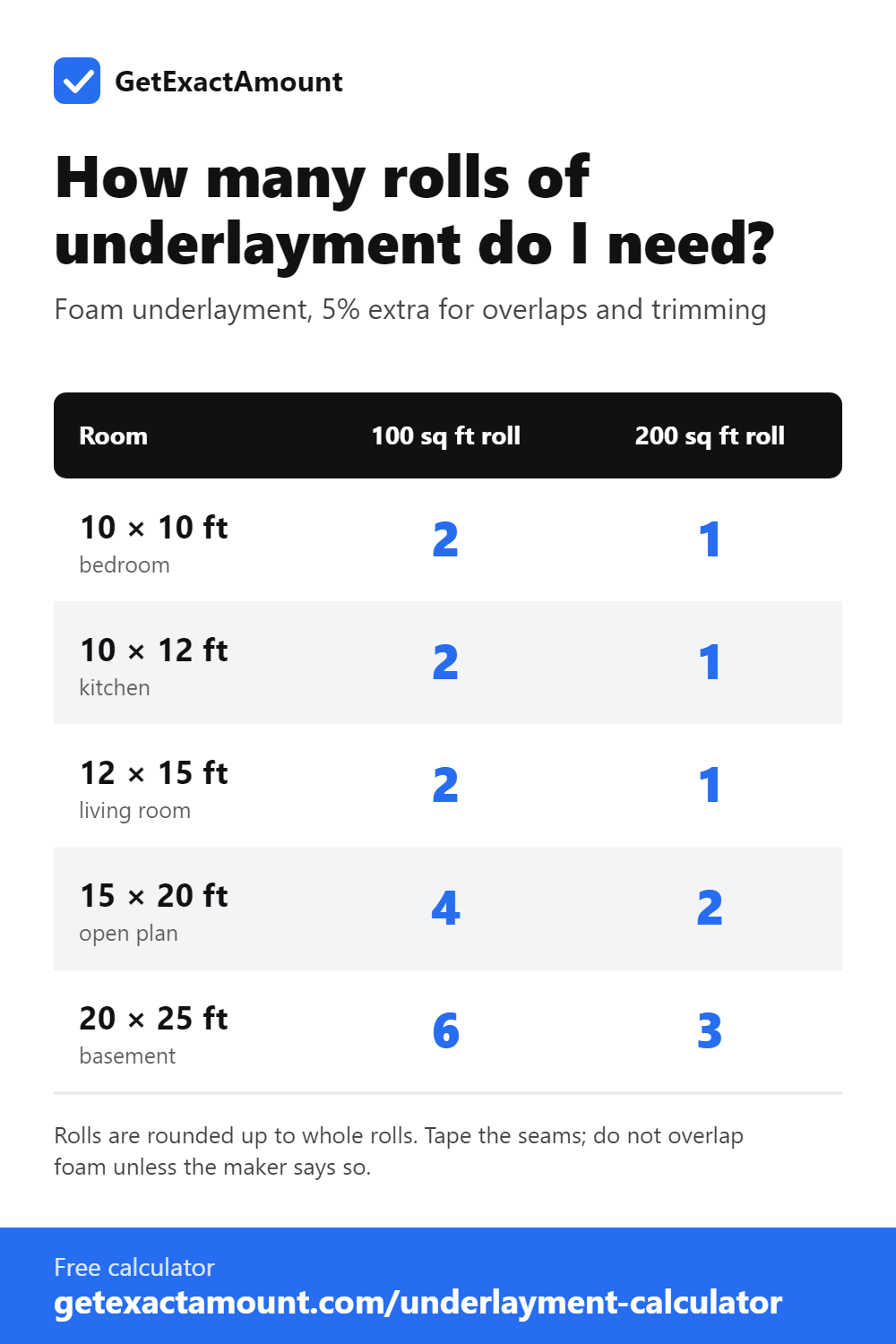
Chart as a table: How many rolls of underlayment do I need?
| Room | 100 sq ft roll | 200 sq ft roll |
|---|---|---|
| 10 × 10 ft (bedroom) | 2 | 1 |
| 10 × 12 ft (kitchen) | 2 | 1 |
| 12 × 15 ft (living room) | 2 | 1 |
| 15 × 20 ft (open plan) | 4 | 2 |
| 20 × 25 ft (basement) | 6 | 3 |
Which underlayment do I need?
| Subfloor | Underlayment | Why |
|---|---|---|
| Wood or plywood, upper floors | Foam (or cork for sound) | Cushions small bumps and reduces footstep noise. |
| Concrete slab | Foam with vapor barrier, or film plus foam | Moisture rising from the slab damages laminate. |
| Planks with an attached pad | Film only, on concrete | A second cushion makes joints flex and fail. |
Common mistakes
- Overlapping foam. It should butt edge to edge; overlaps leave ridges you can feel through the floor.
- Leaving film seams untaped. Moisture finds its way through every gap.
- Running underlayment strips in the same direction as the planks, so the seams stack up.
- Using carpet pad under laminate. It is far too soft for click joints.
What else you'll need
- Seam tape (foil or the tape the maker specifies).
- A utility knife and straightedge.
- 6-mil polyethylene sheeting for concrete, if your underlayment has no barrier.
- A staple gun for wood subfloors, if the maker recommends it.
Frequently asked questions
How many rolls of underlayment do I need?
Divide the floor area plus 5% by the roll coverage. 180 sq ft of foam needs 2 rolls of 100 sq ft. Overlapped film needs more, because the overlap is used twice.
Do I tape underlayment seams?
Yes. Tape foam seams to stop strips shifting, and tape film overlaps to keep moisture out.
Do I need a vapor barrier on a wood subfloor?
Usually not; the wood needs to breathe. Use a vapor barrier over concrete, and follow the flooring maker's rules for basements.
Can I lay two layers of underlayment?
No. A double cushion lets the planks flex at the joints. If you need a moisture barrier as well, use one product that includes it.
Related calculators
This is an estimate. Actual use depends on the material, the surface, the installation method, waste and site conditions. Check quantities with your supplier before you buy.