Tile Calculator for Floors and Walls
Enter your room size and tile size to see how many tiles and boxes to buy, with waste for cuts and an estimated cost.
Your estimate
Buy 23 boxes
230 tiles · 10 tiles per box
- Floor area
- 208 sq ft
- Tiles needed
- 225 tiles
- Waste
- 10%straight layout
- Tile
- 12 × 12 in, 1/8 in joint
Add a price to see the cost.
How we got this: 208 sq ft × 1.10 ÷ 1.021 sq ft per tile (incl. 1/8 in joint) = 224.1, rounded up to 225 tiles, then to 23 boxes of 10.
Buy every box from the same production batch. Shade and size can differ between batches, so keep 1 spare box for repairs.
How the calculation works
- Floor area. Length × width for each area, added together, minus anything you subtract (an island or a tub).
- Tiles. Area ÷ the space one tile takes, including its grout joint. A 12 × 12 in tile with a 1/8 in joint covers 1.021 sq ft.
- Waste. We add 10–20% for cuts and breakage, depending on the layout.
- Boxes. Tiles ÷ tiles per box, always rounded up. You can't buy part of a box.
Imperial example: a 13 × 16 ft floor is 208 sq ft. With 12 × 12 in tile, a 1/8 in joint and 10% waste you need 225 tiles, or 23 boxes of 10.
Metric example: a 4 × 5 m floor is 20 m². With 600 × 600 mm tile, a 3 mm joint and 10% waste you need 61 tiles, or 16 boxes of 4.
Guides to save and share
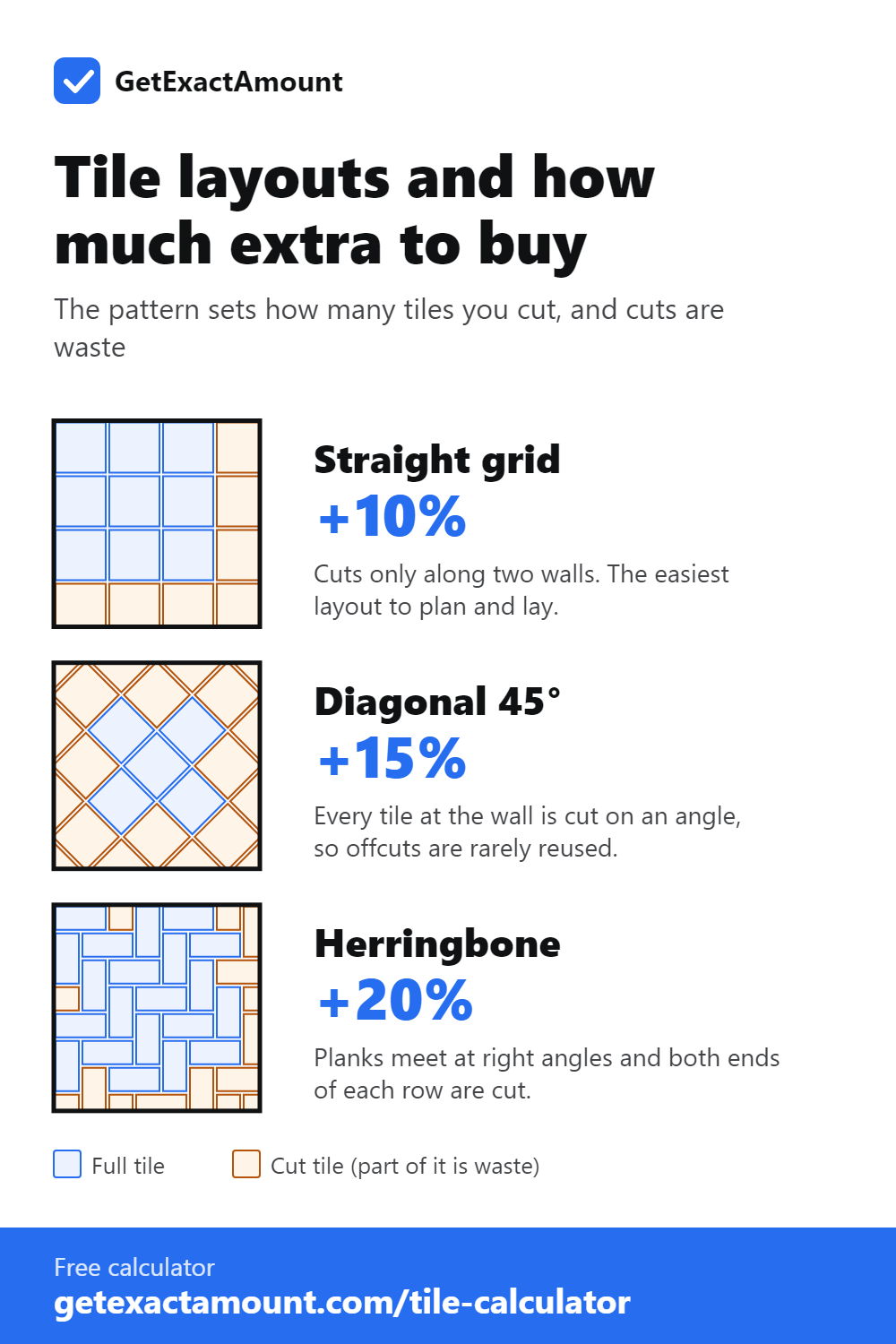
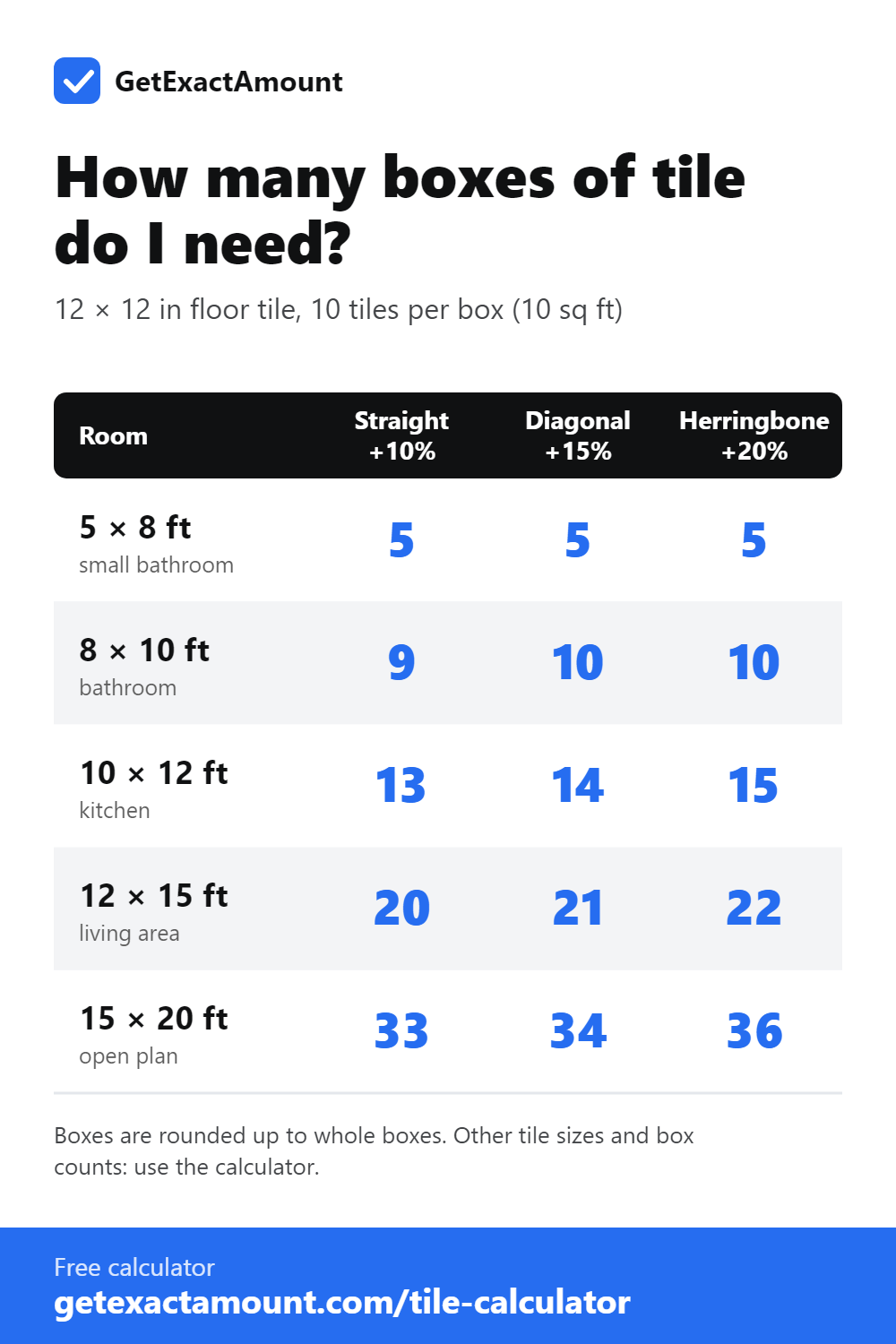
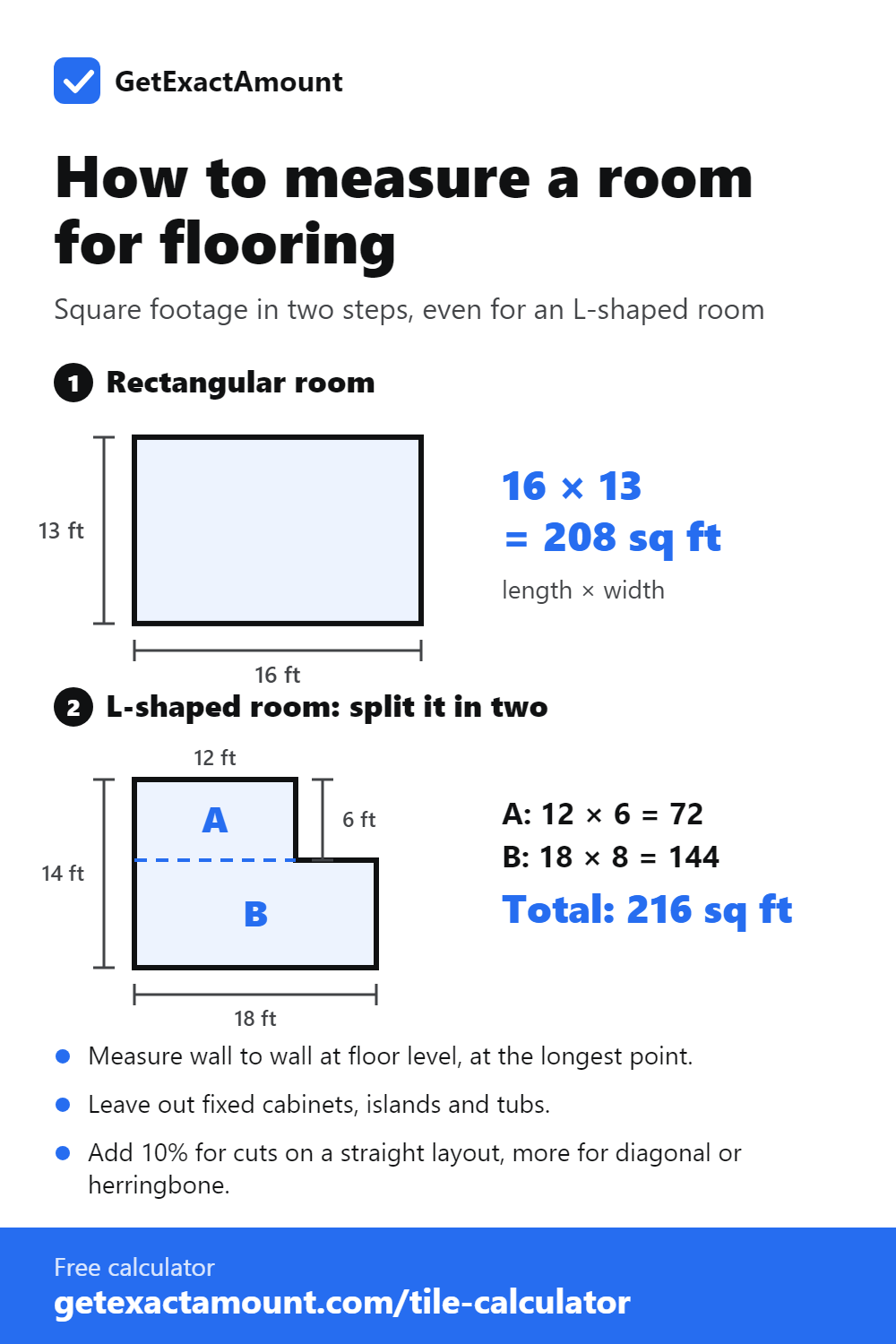
Chart as a table: How many boxes of tile do I need?
| Room | Straight +10% | Diagonal +15% | Herringbone +20% |
|---|---|---|---|
| 5 × 8 ft (small bathroom) | 5 | 5 | 5 |
| 8 × 10 ft (bathroom) | 9 | 10 | 10 |
| 10 × 12 ft (kitchen) | 13 | 14 | 15 |
| 12 × 15 ft (living area) | 20 | 21 | 22 |
| 15 × 20 ft (open plan) | 33 | 34 | 36 |
How much waste should I add?
| Layout | Extra tile | Why |
|---|---|---|
| Straight (grid) | 5–10% | Cuts only along the walls. |
| Diagonal (45°) | 10–15% | Every edge tile is cut on an angle. |
| Herringbone | 15–20% | Many small cuts at every wall. |
| Large format (24 in / 600 mm+) | Add 5% | One broken tile is a bigger share of the job. |
Common mistakes
- Measuring in feet but entering inches (or meters and centimeters). Check the unit next to each field.
- Skipping waste on a diagonal layout. 5% is not enough for 45° cuts.
- Buying a second batch later. Tiles from another batch may not match in shade or size.
- Forgetting closets and doorways. Include every area that gets the same tile.
What else you'll need
- Tile adhesive (thinset): 1 bag of 50 lb covers roughly 45–95 sq ft, depending on the trowel. Tile Adhesive Calculator
- Grout and a rubber float. Grout Calculator
- Spacers, or leveling clips for tiles over 15 in.
- Notched trowel, tile cutter or wet saw, sponge and buckets.
- Silicone sealant (caulk) for corners and edges.
Frequently asked questions
How many tiles do I need for a 10×10 room?
A 10 × 10 ft room is 100 sq ft. With 12 × 12 in tile, a 1/8 in joint and 10% waste, you need 108 tiles. At 10 per box, buy 11 boxes.
How much extra tile should I buy?
Add 10% for a straight layout, 15% for diagonal and 20% for herringbone. Keep one spare box for future repairs.
Does the grout joint change how many tiles I need?
Slightly. Each joint adds a little area to every tile, so wider joints mean fewer tiles. For 12 × 12 in tile, a 1/8 in joint saves about 2%.
How many tiles are in a box?
It depends on the tile. A box of 12 × 12 in tile often has 10 to 15 tiles; a box of 24 × 24 in tile often has 3 or 4. The label lists the count and the coverage in sq ft.
How do I measure an L-shaped room for tile?
Split it into two rectangles, measure each, and add them with "Add another area". The calculator adds the areas before working out tiles and boxes.
Related calculators
This is an estimate. Actual use depends on the material, the surface, the installation method, waste and site conditions. Check quantities with your supplier before you buy.