Grout Calculator: How Much Grout for Your Tile
Enter the area, tile size, joint width and tile thickness. We use the manufacturer formula to work out the grout and the bags to buy.
Your estimate
Buy 1 bag
1 bag (10 lb) · 7.2 lb of grout
- Area
- 100 sq ft
- Tile and joint
- 12 in × 12 in, 1/8 in joint
- Grout per area
- 0.065 lb/sq ft
- Grout
- 7.2 lb10% waste
Add a price per bag to see the cost.
How we got this: (L + W) ÷ (L × W) × joint × depth × 1.6 = 0.065 lb/sq ft; × 100 sq ft × 1.10 = 7.2 lb.
Buy all grout from the same batch, and test the dry color on a spare tile first: color varies between lots.
How the calculation works
- Grout per area. (Tile length + tile width) ÷ (tile length × tile width) × joint width × joint depth × density. With sizes in millimeters and density in kg per liter, the answer is in kg per m².
- Total. Rate × area, plus 10% for grout left in the bucket and on the sponge.
- Bags. We fill the total with the bag sizes sold where you shop.
Imperial example: 100 sq ft of 12 × 12 in tile, 3/8 in thick, with 1/8 in joints takes 7.2 lb with waste: one 10 lb bag.
Metric example: 10 m² of 300 × 300 mm tile, 8 mm thick, with 3 mm joints takes 2.8 kg with waste: one 5 kg bag.
Guides to save and share
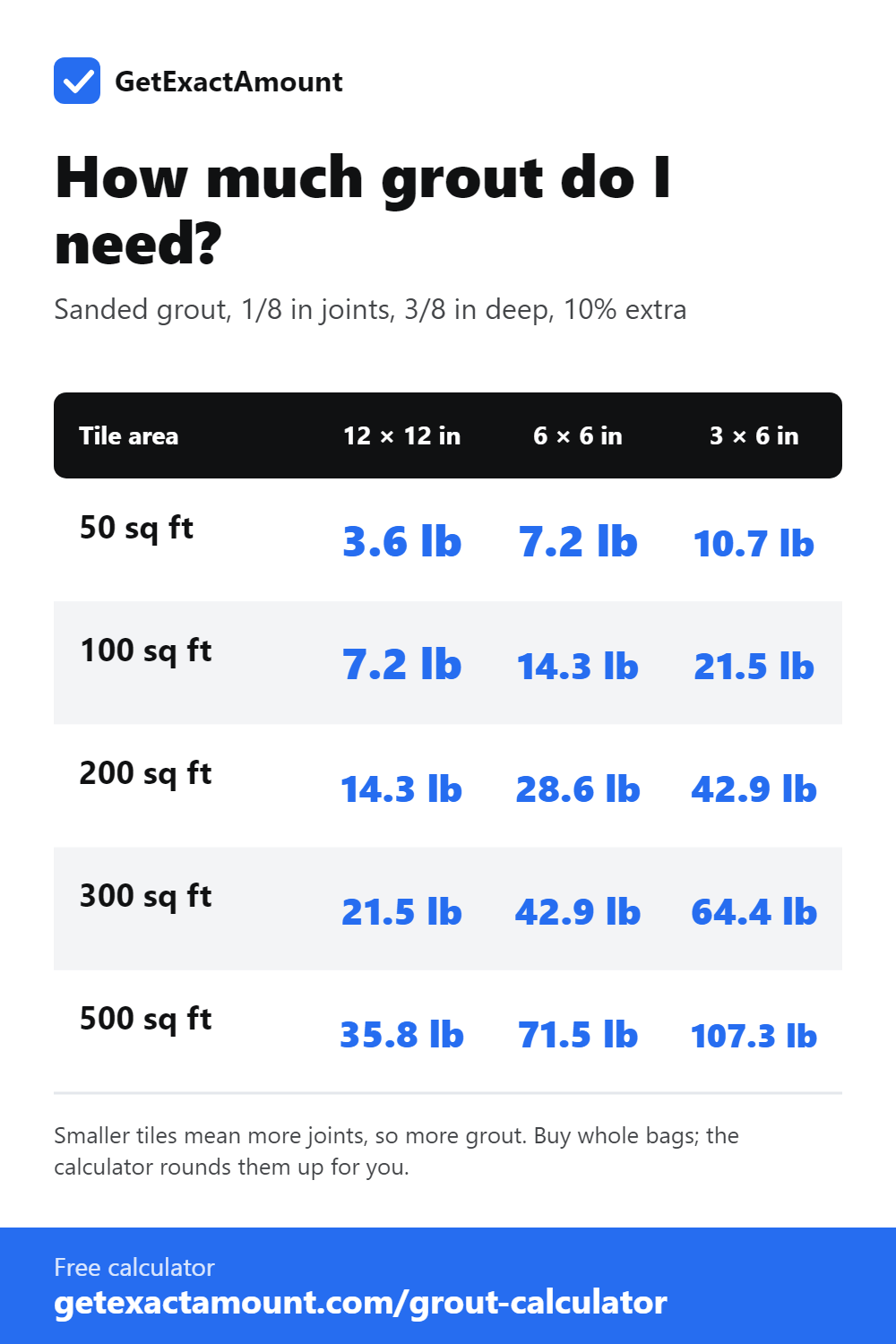
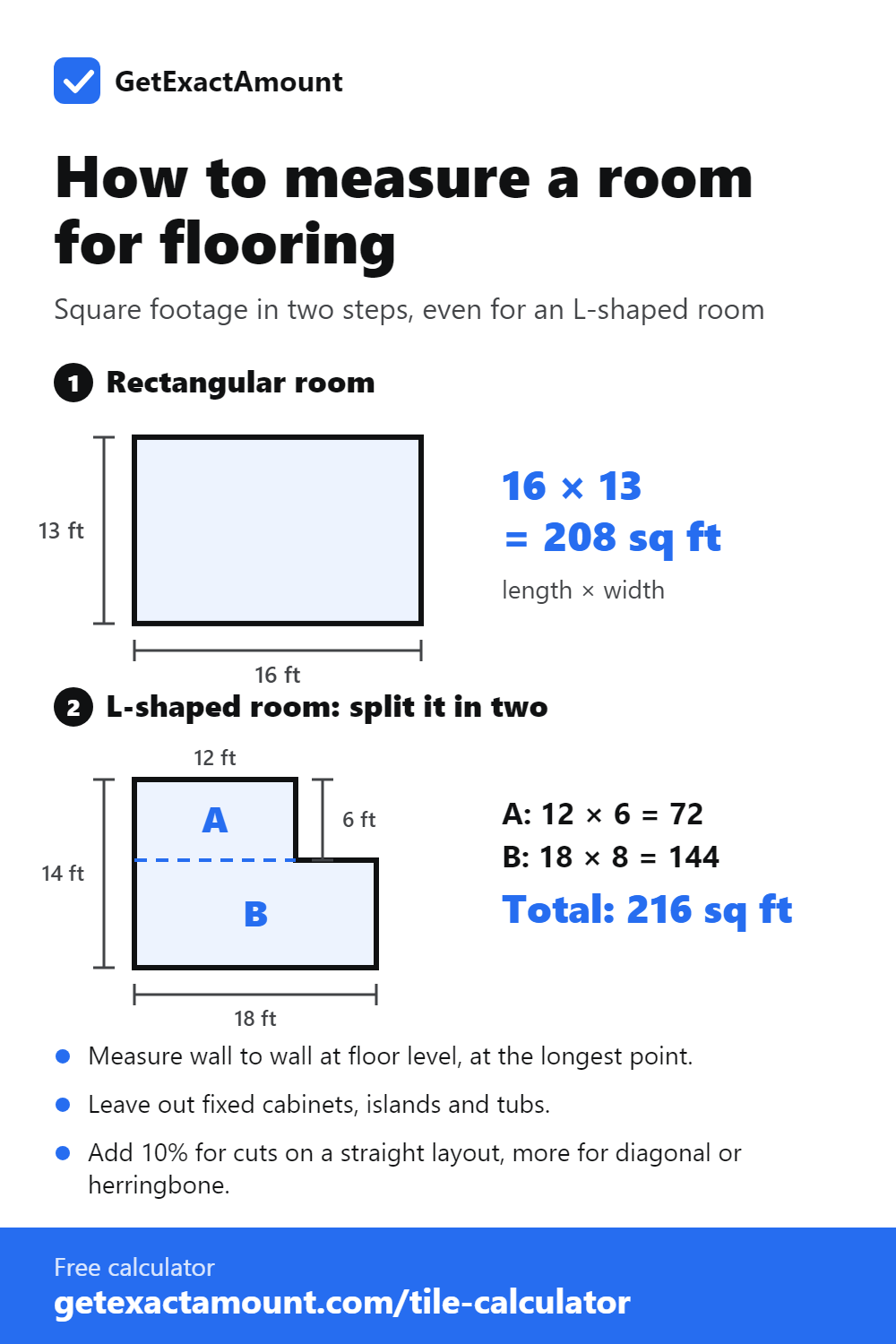
Chart as a table: How much grout do I need?
| Tile area | 12 × 12 in | 6 × 6 in | 3 × 6 in |
|---|---|---|---|
| 50 sq ft | 3.6 lb | 7.2 lb | 10.7 lb |
| 100 sq ft | 7.2 lb | 14.3 lb | 21.5 lb |
| 200 sq ft | 14.3 lb | 28.6 lb | 42.9 lb |
| 300 sq ft | 21.5 lb | 42.9 lb | 64.4 lb |
| 500 sq ft | 35.8 lb | 71.5 lb | 107.3 lb |
How much grout per 100 sq ft?
| Tile size | Grout | Why it changes |
|---|---|---|
| 4 × 4 in (100 mm) | about 19.5 lb (8.8 kg) | Small tiles mean many more joints. |
| 12 × 12 in (300 mm) | about 6.5 lb (2.9 kg) | The common floor tile. |
| 12 × 24 in (300 × 600 mm) | about 4.9 lb (2.2 kg) | Long tiles have fewer joints per square foot. |
| 24 × 24 in (600 mm) | about 3.3 lb (1.5 kg) | Large format: the fewest joints. |
Common mistakes
- Using sanded grout in joints under 1/8 in (3 mm). The sand cannot fill them.
- Using unsanded grout in wide joints. It shrinks and cracks.
- Guessing for mosaics. Small tiles take several times more grout than large ones.
- Buying grout in two batches. The color can differ between lots.
What else you'll need
- A rubber grout float.
- A grout sponge and two buckets of clean water.
- A mixing paddle.
- Grout sealer for cement grout in showers and kitchens.
- Silicone sealant (caulk) for corners and changes of plane.
Frequently asked questions
How much grout do I need per square foot?
For 12 × 12 in tile with 1/8 in joints, 3/8 in deep, about 0.065 lb per sq ft (0.32 kg per m²). Smaller tiles and wider joints take more.
How many square feet does a 25 lb bag of grout cover?
It depends on the tile and joint. With 12 × 12 in tile and 1/8 in joints, about 380 sq ft; with 4 × 4 in tile, about 130 sq ft. The bag has a coverage chart.
Sanded or unsanded grout: which do I need?
Unsanded for joints up to 1/8 in (3 mm), sanded for wider joints. Epoxy grout works for both and does not need sealing.
What grout joint width should I use?
Rectified porcelain is often laid with 1/16–1/8 in (2–3 mm) joints. Most other floor tile uses 1/8–3/16 in (3–5 mm); handmade or rustic tile may need wider joints.
Do I need to seal grout?
Seal cement grout in showers, kitchens and entryways once it has cured (see the bag for timing). Epoxy grout does not need sealing.
Related calculators
This is an estimate. Actual use depends on the material, the surface, the installation method, waste and site conditions. Check quantities with your supplier before you buy.