Tile Adhesive (Thinset) Calculator: Bags by Trowel Size
Enter the area and tile size. We pick the trowel notch for that tile and work out how many bags of adhesive (thinset) to buy.
Your estimate
Buy 3 bags
3 bags (50 lb) of thinset
- Area
- 120 sq ft
- Trowel
- 1/4 × 3/8 in
- Coverage rate
- 0.778 lb/sq ft
- Adhesive
- 103 lb10% waste
Add a price per bag to see the cost.
How we got this: 120 sq ft × 0.778 lb/sq ft × 1.10 = 103 lb, rounded up to whole bags.
Lift a tile after setting a few: the back should be at least 80% covered (95% in wet areas).
How the calculation works
- Trowel. Bigger tiles need a deeper notch: 1/4 × 1/4 in (6 mm) up to 8 in tiles, 1/4 × 3/8 in (10 mm) up to 15 in, and 1/2 × 1/2 in (12 mm) above that.
- Rate. Each notch leaves a known amount of adhesive: about 2.6, 3.8 and 5.4 kg per m². Back-buttering adds about 1 kg per m².
- Bags. Area × rate plus 10% for what stays on the trowel and in the bucket, rounded up to whole bags.
Imperial example: 120 sq ft with a 1/4 × 1/4 in trowel takes about 32 kg (70 lb) with waste: 2 bags of 50 lb.
Metric example: 10 m² of 600 mm tiles with a 12 mm trowel and back-buttering takes 70.4 kg with waste: 4 bags of 20 kg.
Guides to save and share
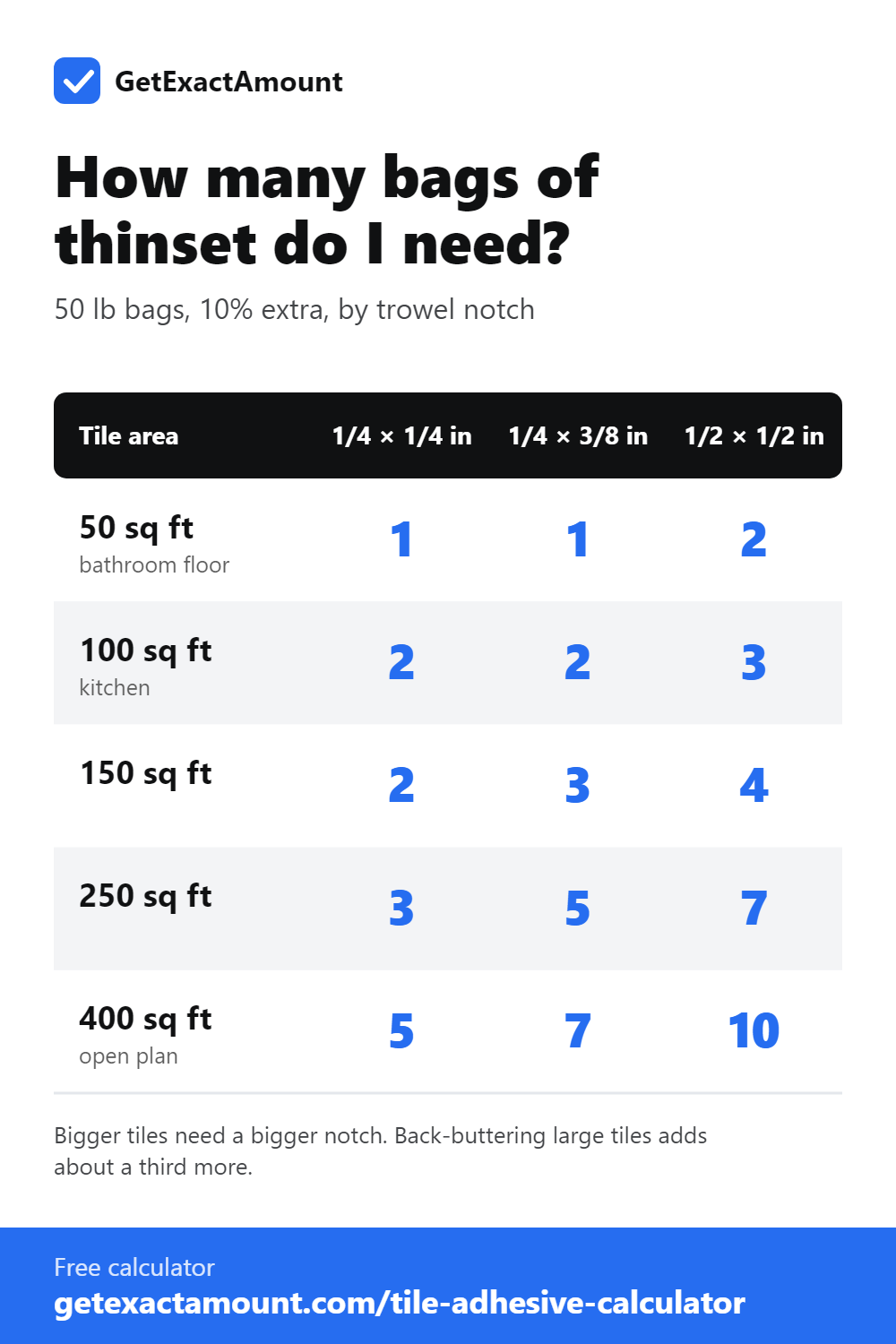
Chart as a table: How many bags of thinset do I need?
| Tile area | 1/4 × 1/4 in | 1/4 × 3/8 in | 1/2 × 1/2 in |
|---|---|---|---|
| 50 sq ft (bathroom floor) | 1 | 1 | 2 |
| 100 sq ft (kitchen) | 2 | 2 | 3 |
| 150 sq ft | 2 | 3 | 4 |
| 250 sq ft | 3 | 5 | 7 |
| 400 sq ft (open plan) | 5 | 7 | 10 |
Which trowel, and how far does a bag go?
| Tile (longest side) | Trowel notch | Coverage per 50 lb (22.7 kg) bag |
|---|---|---|
| Up to 8 in (200 mm) | 1/4 × 1/4 in square (6 mm) | 90–100 sq ft (about 8.8 m²) |
| 8–15 in (200–380 mm) | 1/4 × 3/8 in square (10 mm) | 60–70 sq ft (about 6 m²) |
| Over 15 in (380 mm) | 1/2 × 1/2 in square (12 mm) | 40–50 sq ft (about 4.2 m²), less with back-buttering |
Common mistakes
- Using a small trowel for large tiles. It leaves hollow spots that crack under load.
- Skipping back-buttering on tiles over 15 in (380 mm).
- Mixing more than you can use within the pot life printed on the bag.
- Using ready-mixed tub adhesive on floors. It is for small wall tiles only.
What else you'll need
- The right notched trowel, plus a flat trowel for back-buttering.
- A mixing paddle, drill and buckets.
- Spacers or leveling clips.
- Primer for absorbent subfloors.
- Waterproofing membrane for showers and wet rooms.
Frequently asked questions
How much tile adhesive do I need per square metre?
About 2.5 kg per m² with a 6 mm trowel, 4 kg with a 10 mm trowel and 5.5 kg with a 12 mm trowel. Add about 1 kg per m² if you back-butter.
How many square feet does a 50 lb bag of thinset cover?
About 90–100 sq ft with a 1/4 × 1/4 in trowel, 60–70 sq ft with 1/4 × 3/8 in, and 40–50 sq ft with 1/2 × 1/2 in. The bag lists coverage for each trowel.
What size trowel should I use for my tile?
As a rule: 1/4 × 1/4 in (6 mm) for tiles up to 8 in, 1/4 × 3/8 in (10 mm) up to 15 in, and 1/2 × 1/2 in (12 mm) for larger tiles. Check coverage by lifting a tile.
What is back-buttering and when do I need it?
Spreading a thin layer of adhesive on the back of the tile before setting it. It is needed for tiles over 15 in (380 mm), natural stone and anything in a shower or outdoors.
Can I use ready-mixed tile adhesive on a floor?
No. Ready-mixed tub adhesive is for small wall tiles in dry areas. Floors need a cement-based powder adhesive (thinset) mixed with water.
Related calculators
This is an estimate. Actual use depends on the material, the surface, the installation method, waste and site conditions. Check quantities with your supplier before you buy.