Hardwood Flooring Calculator: Boxes, Cleats & Paper
Enter the room and the coverage on the box. We add waste for your layout, count the flooring cleats from your plank width, and add the paper that goes underneath.
Your estimate
Buy 10 boxes
20 sq ft per box · 3 1/4 in planks
- Floor area
- 180 sq ft
- Boxes cover
- 200 sq ft
- Waste
- 10%straight layout
- Flooring cleats
- about 1,100 · 2 × box of 1,000
- Underlayment paper
- 1 roll
Add a price to see the cost.
How we got this: 180 sq ft × 1.10 ÷ 20 sq ft per box = 9.9, rounded up to 10 boxes. Cleats: one per plank width every 8 in, plus 10%.
Let the boxes acclimate in the room for the time the manufacturer gives (often 3–7 days), and check that wood and subfloor moisture are within 2–4% of each other.
How the calculation works
- Boxes. Floor area plus waste, divided by the coverage on the carton, rounded up. Hardwood waste covers cuts and the boards you reject for defects.
- Cleats. One fastener per plank width at each nailing point, so narrow planks need more. We add 10% for the extra nails near each plank end.
- Paper. Red rosin paper or 15 lb felt over the subfloor, overlapped by about 4 in (100 mm).
Imperial example: a 12 × 15 ft room is 180 sq ft. With 10% waste and 20 sq ft per carton, buy 10 cartons. 3 1/4 in strip nailed every 8 in takes about 1,100 cleats: 2 boxes of 1,000.
Metric example: a 4 × 5 m room is 20 m². With 10% waste and 1.9 m² per carton, buy 12 cartons. 83 mm boards nailed every 200 mm take about 1,330 cleats.
Guides to save and share
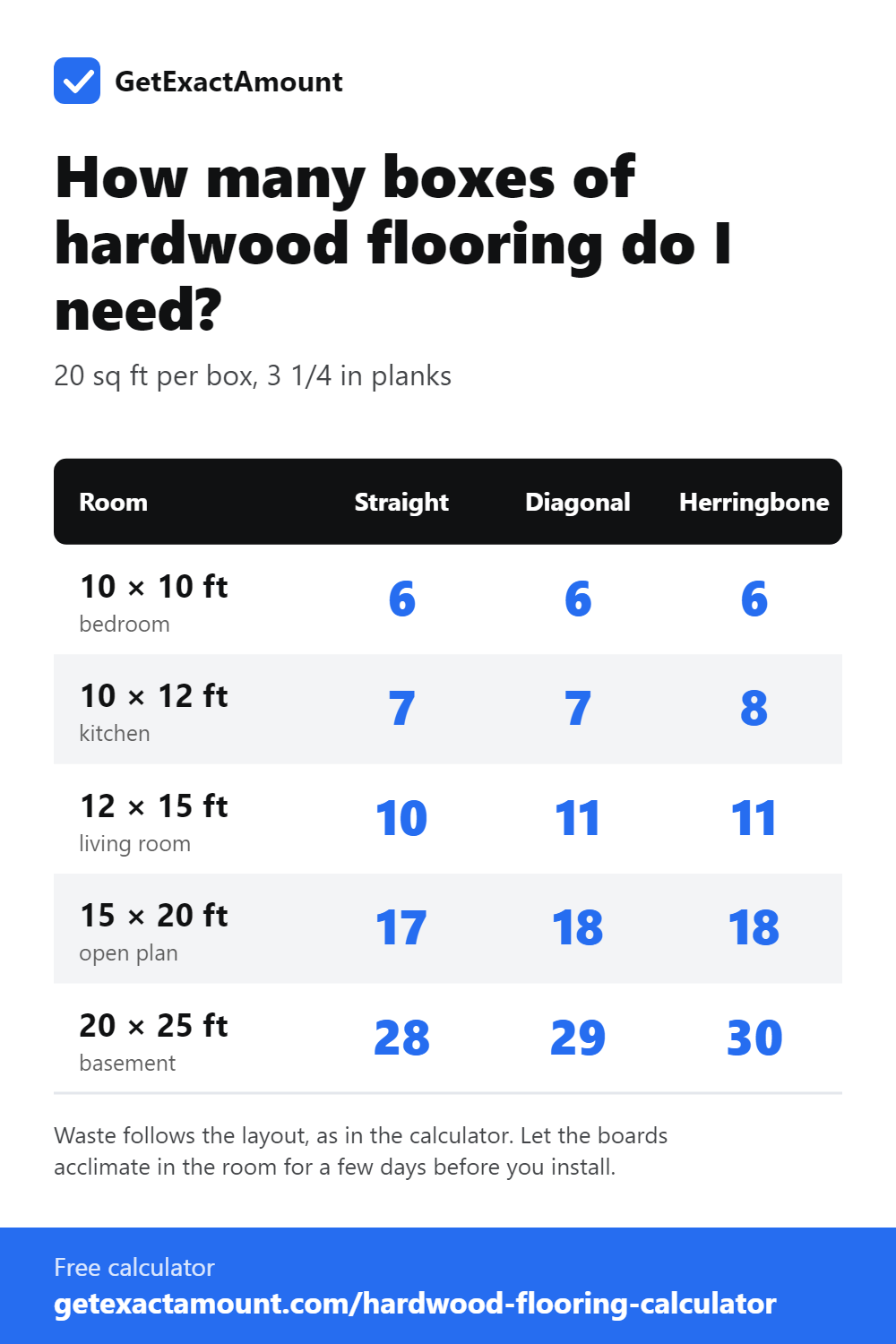
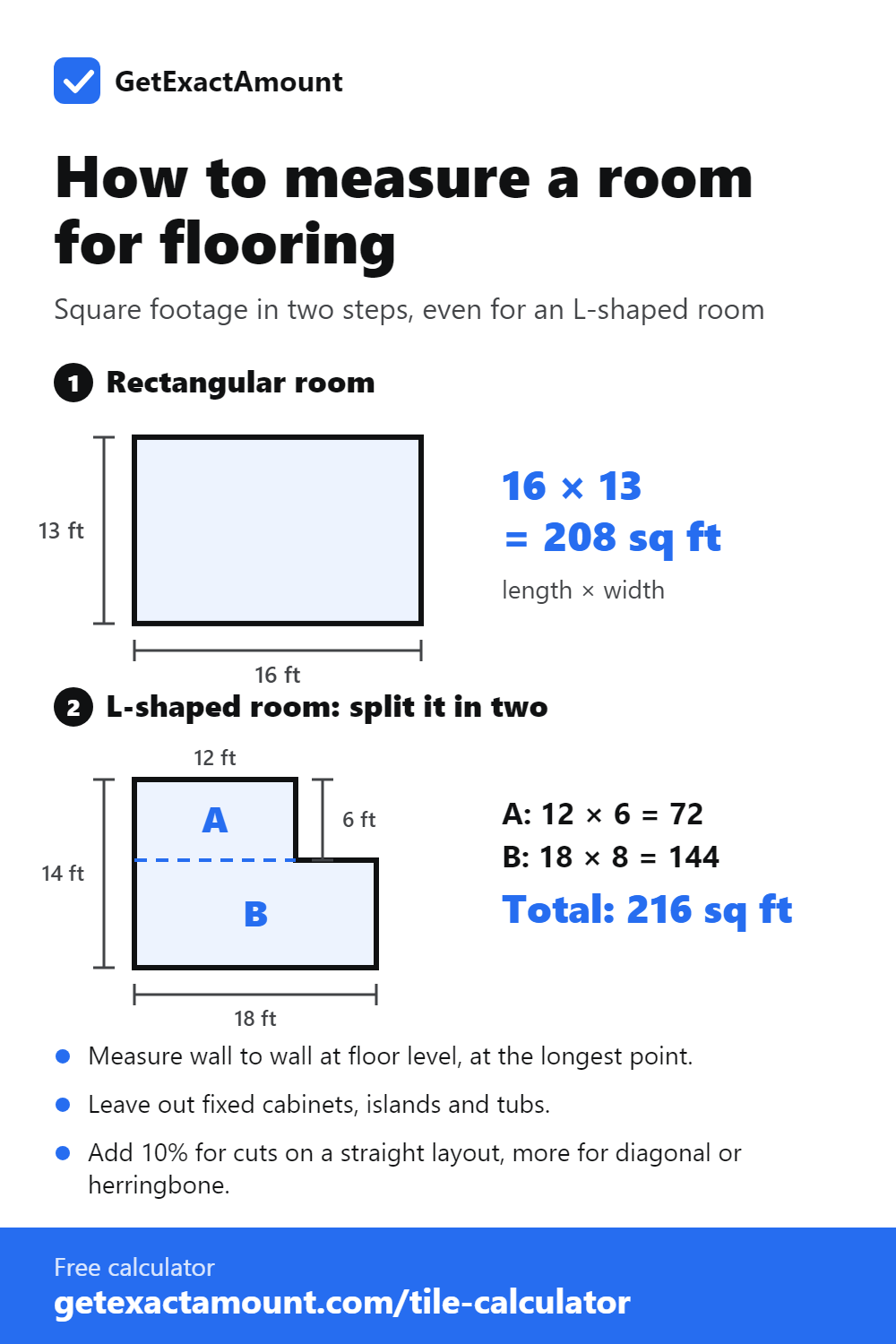
Chart as a table: How many boxes of hardwood flooring do I need?
| Room | Straight | Diagonal | Herringbone |
|---|---|---|---|
| 10 × 10 ft (bedroom) | 6 | 6 | 6 |
| 10 × 12 ft (kitchen) | 7 | 7 | 8 |
| 12 × 15 ft (living room) | 10 | 11 | 11 |
| 15 × 20 ft (open plan) | 17 | 18 | 18 |
| 20 × 25 ft (basement) | 28 | 29 | 30 |
How much waste should I add?
| Situation | Extra | Why |
|---|---|---|
| Straight, select or clear grade | 10% | End cuts and the odd board with a defect. |
| Diagonal | 15% | Angled cuts along every wall. |
| Herringbone or parquet | 20% | Many short, precise pieces. |
| Character or #2 common grade | Add 5–10% | More knots and color variation to cut around. |
Common mistakes
- Nailing solid hardwood straight onto concrete. It needs a wood subfloor, or use engineered flooring.
- Skipping acclimation and moisture checks. Boards that are wetter or drier than the subfloor will cup or gap.
- Leaving no expansion gap. Leave about 3/4 in (19 mm) at the walls, hidden under the baseboard.
- Racking from one carton at a time. Pull from several cartons so color and length variation spreads out.
What else you'll need
- A flooring nailer (pneumatic or manual) with cleats sized for your board thickness.
- Red rosin paper or 15 lb felt.
- A miter saw and a table saw or jigsaw.
- A moisture meter for the wood and the subfloor.
- Finishing nails or a brad nailer for the first and last rows, and wood filler.
Frequently asked questions
How much hardwood flooring do I need?
Floor area plus 10% for a straight layout, 15% for diagonal and 20% for herringbone. A 12 × 15 ft room needs about 198 sq ft: 10 cartons at 20 sq ft each.
How many nails do I need for hardwood flooring?
About 5–6 cleats per sq ft for 3 1/4 in strip nailed every 8 in, or roughly 1,000 per 180 sq ft. Wider boards need fewer.
Can I install solid hardwood over concrete?
Not directly. Solid hardwood needs a wood subfloor, and it is not recommended below grade. Engineered wood can be glued or floated over concrete.
How long should hardwood acclimate?
As long as the manufacturer says, often 3–7 days in the room with the heating or air conditioning running. What matters is that the wood and subfloor moisture are close: within 2–4% of each other.
Which way should hardwood boards run?
Usually across the floor joists, for strength, and parallel to the longest wall. The direction does not change how much you buy.
Related calculators
This is an estimate. Actual use depends on the material, the surface, the installation method, waste and site conditions. Check quantities with your supplier before you buy.