Paver Calculator: Pavers, Base Gravel, Sand & Edging
Enter your patio or driveway size and the paver size to see how many pavers to buy, and how much gravel, sand and edging go under and around them.
Your estimate
Buy 390 pavers
6 × 9 in pavers · plus base, sand and edging
- Area
- 144 sq ft
- Waste
- 5%straight
- Base gravel
- 2.22 cu yd ≈ 3 tons
- Bedding sand
- 0.49 cu yd ≈ 0.7 tons
- Joint sand
- 3 bags (50 lb)
- Edge restraint
- 48 ft
Add a price to see the cost of the pavers.
How we got this: 144 sq ft × 1.05 ÷ 0.388 sq ft per paver (incl. joint) = 389.6, rounded up to 390. Base and sand include 25% and 10% for compaction.
Pavers vary in color between pallets: mix pavers from 2–3 pallets as you lay them.
How the calculation works
- Pavers. Area plus waste, divided by the space one paver takes including its joint, rounded up.
- Base gravel. Area × base depth, plus 25% because crushed stone compacts. We show it in cubic yards and tons (or m³ and tonnes) at about 2,700 lb per cubic yard (1.6 t/m³).
- Bedding sand. Area × 1 in (25 mm), plus 10%.
- Joint sand and edging. Joint sand from the joint volume, and edge restraint for the perimeter, minus any side against a wall.
Imperial example: a 12 × 12 ft patio of 6 × 9 in pavers with 5% waste needs 390 pavers, 2.2 cu yd (about 3 tons) of base gravel, 0.5 cu yd of sand and 3 bags of joint sand. With one side against the house, you need 36 ft of edging.
Metric example: a 4 × 3 m patio of 200 × 100 mm block paving needs 603 pavers, 1.5 m³ (2.4 tonnes) of sub-base and 0.33 m³ of sand.
Guides to save and share
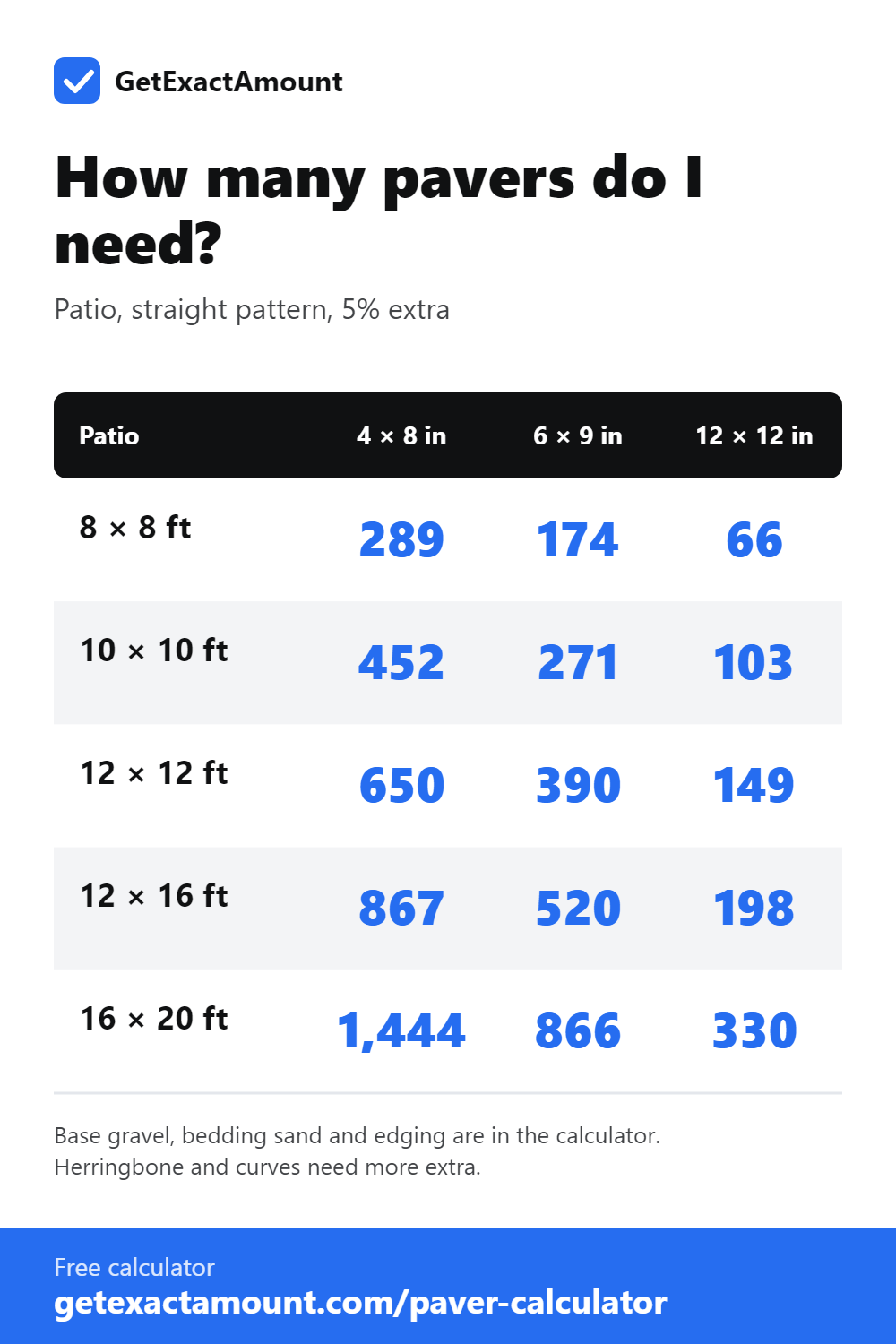
Chart as a table: How many pavers do I need?
| Patio | 4 × 8 in | 6 × 9 in | 12 × 12 in |
|---|---|---|---|
| 8 × 8 ft | 289 | 174 | 66 |
| 10 × 10 ft | 452 | 271 | 103 |
| 12 × 12 ft | 650 | 390 | 149 |
| 12 × 16 ft | 867 | 520 | 198 |
| 16 × 20 ft | 1,444 | 866 | 330 |
How much waste should I add?
| Pattern | Extra pavers | Why |
|---|---|---|
| Straight or running bond | 5–10% | Cuts only along the edges. |
| Herringbone (45°) | 10–15% | Angled cuts on every edge. |
| Curves and circles | 15–20% | Many small cuts that cannot be reused. |
Common mistakes
- Skimping on the base. Most paver failures are a thin or poorly compacted base, not the pavers.
- Using bedding sand to make up height. More than 1 1/2 in (40 mm) of sand shifts and ruts.
- Laying the patio flat. Slope it about 1/4 in per foot (2%) away from the house.
- Ordering gravel by loose volume without allowing for compaction.
What else you'll need
- Crushed stone base (road base, MOT Type 1, or similar).
- Bedding sand and polymeric or kiln-dried joint sand.
- Edge restraint with spikes.
- Geotextile fabric under the base.
- A plate compactor (rental), screed rails, a rubber mallet and a masonry saw.
Frequently asked questions
How many pavers do I need for a 10×10 patio?
A 10 × 10 ft patio is 100 sq ft. With 6 × 9 in pavers, 1/8 in joints and 5% waste, you need 271 pavers.
How much gravel do I need under pavers?
For a 4 in compacted base, order about 1 1/4 times the volume: a 10 × 10 ft patio needs about 1.5 cu yd, roughly 2 tons of crushed stone.
How much sand do I need for pavers?
A 1 in (25 mm) bedding layer: about 0.34 cu yd (just under half a ton) for a 10 × 10 ft patio, plus joint sand to fill the gaps.
How deep should the base be for a paver driveway?
Usually 8–12 in (200–300 mm) of compacted crushed stone, and more on clay soil or in frost areas. Patios and paths need 4–6 in (100–150 mm).
How much extra should I buy for a herringbone pattern?
Add 10–15% for herringbone, compared with 5–10% for a straight or running bond pattern.
Polymeric sand or regular sand for joints?
Polymeric sand hardens when wet, resists weeds and ants, and stays in the joints better. Regular sand is cheaper but needs topping up.
Related calculators
This is an estimate. Actual use depends on the material, the surface, the installation method, waste and site conditions. Check quantities with your supplier before you buy.