Concrete Calculator: Slabs, Footings and Columns
Enter the size of a slab or the round holes for posts and columns. We give the volume, the number of premix bags, and the ready-mix order rounded the way suppliers sell it.
Your estimate
Buy 62 bags (80 lb)
of premixed concrete, or 1.5 cu yd of ready-mix
- Concrete
- 1.36 cu yd (36.7 cu ft)10% waste
- Premix bags
- 62 × 80 lb
- Ready-mix order
- 1.5 cu yd
Add a price per bag to see the cost.
How we got this: 10 ft × 10 ft × 4 in × 1.10 = 1.36 cu yd. An 80 lb (36 kg) bag makes about 0.6 cu ft (0.017 m³).
That is a lot of bags. Ready-mix is usually cheaper and faster above about 1 cu yd (0.75 m³); ask about short-load fees.
Keep new concrete damp for at least 7 days (cover it or mist it): it keeps gaining strength and cracks less.
How the calculation works
- Volume. Length × width × thickness for a slab, or π × radius² × depth for each round hole, plus 10% for spillage and uneven ground.
- Bags. An 80 lb bag of premix makes about 0.6 cu ft of concrete; a 60 lb bag 0.45 and a 40 lb bag 0.3. Metric bags are worked out at the same yield per kilogram.
- Ready-mix. Trucks deliver in steps, usually 1/4 cu yd (0.25 m³), so we round the order up.
Imperial example: a 10 × 10 ft slab, 4 in thick, needs 1.36 cu yd with waste: 62 bags of 80 lb, or a 1.5 cu yd ready-mix order. Four 12 in post holes 4 ft deep take 24 bags.
Metric example: a 3 × 3 m slab, 100 mm thick, needs 0.99 m³ with waste: 85 bags of 25 kg, or 1.0 m³ of ready-mix.
Guides to save and share
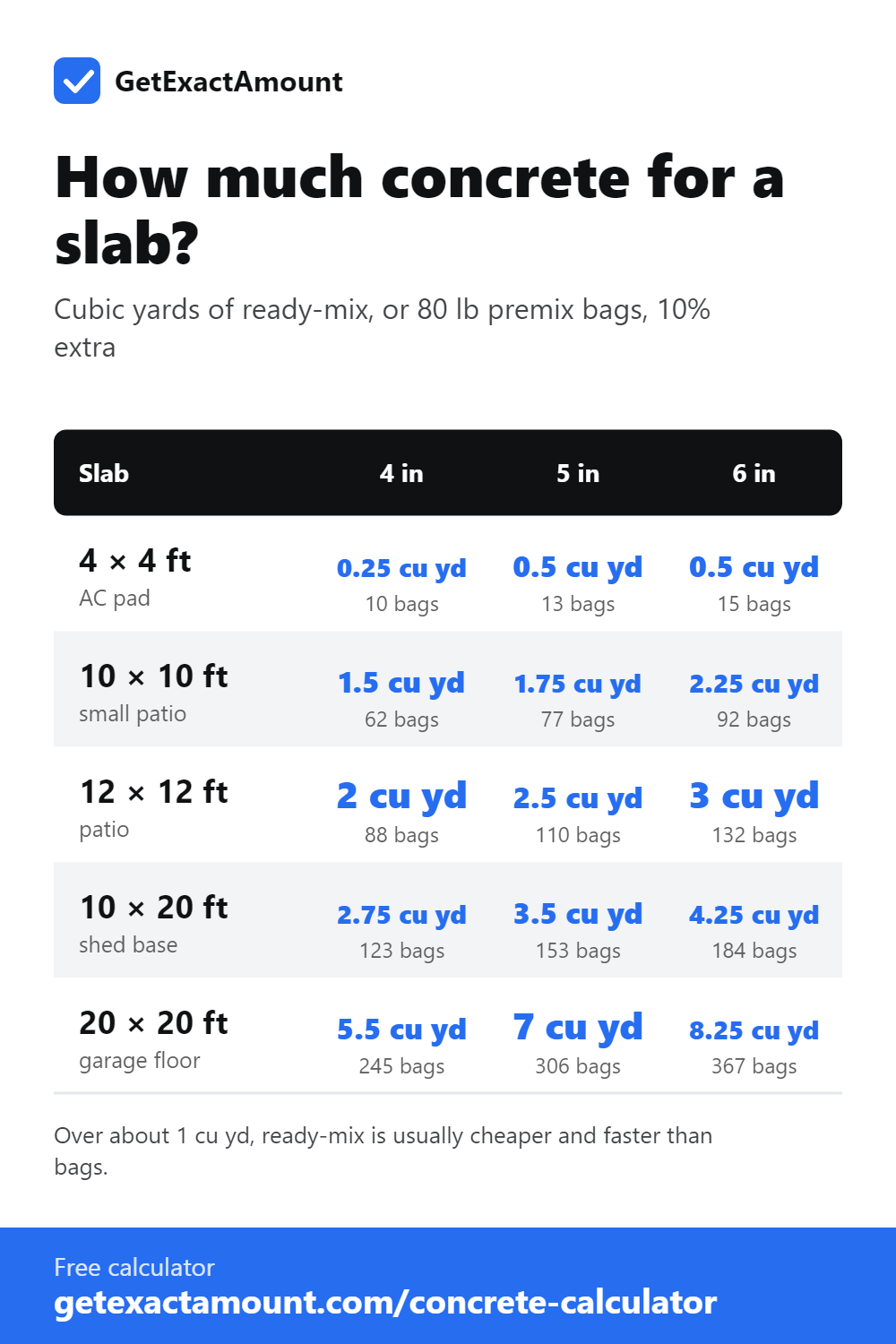
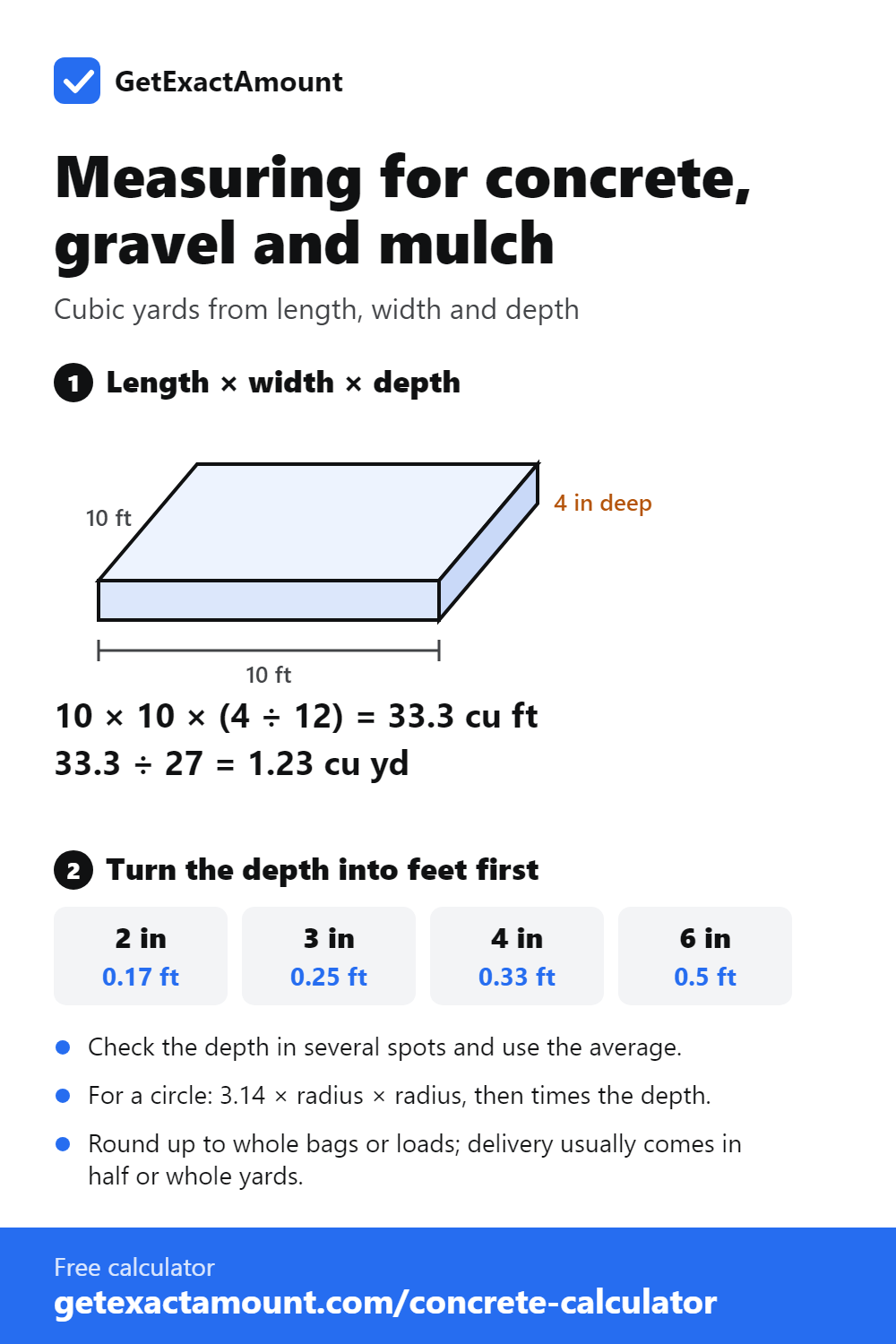
Chart as a table: How much concrete for a slab?
| Slab | 4 in | 5 in | 6 in |
|---|---|---|---|
| 4 × 4 ft (AC pad) | 0.25 cu yd (10 bags) | 0.5 cu yd (13 bags) | 0.5 cu yd (15 bags) |
| 10 × 10 ft (small patio) | 1.5 cu yd (62 bags) | 1.75 cu yd (77 bags) | 2.25 cu yd (92 bags) |
| 12 × 12 ft (patio) | 2 cu yd (88 bags) | 2.5 cu yd (110 bags) | 3 cu yd (132 bags) |
| 10 × 20 ft (shed base) | 2.75 cu yd (123 bags) | 3.5 cu yd (153 bags) | 4.25 cu yd (184 bags) |
| 20 × 20 ft (garage floor) | 5.5 cu yd (245 bags) | 7 cu yd (306 bags) | 8.25 cu yd (367 bags) |
How much waste should I add?
| Job | Extra | Why |
|---|---|---|
| Formed slab on a compacted base | 5% | Formwork holds the shape; only spills. |
| Slab on uneven ground | 10% | Low spots fill with concrete. |
| Post holes and footings dug by hand | 10–15% | Holes are rarely the exact size. |
Common mistakes
- Pouring a slab without a compacted base. Settling soil cracks the slab.
- Running short mid-pour. A joint between old and new concrete is a weak line; order a little extra.
- Mixing bag concrete too wet. Use the water on the bag.
- Letting fresh concrete dry out in the sun. Keep it damp for a week.
What else you'll need
- Formwork boards, stakes and screws.
- Compacted gravel base: Gravel Calculator
- Reinforcing mesh or rebar, and chairs to hold it up.
- A mixer (or wheelbarrow and hoe), a screed board, a float and an edger.
- Curing cover or plastic sheet.
Frequently asked questions
How many bags of concrete are in a cubic yard?
About 45 bags of 80 lb, 60 bags of 60 lb or 90 bags of 40 lb, before waste.
How thick should a concrete slab be?
At least 4 in (100 mm) for patios and sheds, and 5–6 in (125–150 mm) for driveways and garage floors.
When is ready-mix cheaper than bags?
Usually above about 1 cu yd (0.75 m³). Smaller loads may carry a short-load fee, so compare both.
How do I work out concrete for post holes?
Use the round column option: diameter, depth and number of holes. A 12 in hole 4 ft deep takes about 3.1 cu ft, or 6 bags of 80 lb.
How long before I can walk or drive on new concrete?
Walk on it after 1–2 days and drive on it after about 7 days. It reaches full design strength in about 28 days.
Related calculators
This is an estimate. Actual use depends on the material, the surface, the installation method, waste and site conditions. Check quantities with your supplier before you buy.