Sand Calculator: Bags, Cubic Yards and Tons
Enter the area and depth and pick what the sand is for. We give the bags to buy, the weight, and the bulk order rounded the way suppliers deliver.
Your estimate
Order 1 cu yd
of play sand ≈ 1.35 tons, or 51 bags (50 lb)
- Area
- 36 sq ft
- Volume
- 0.93 cu yd (25.2 cu ft)5% waste
- Weight
- 1.26 tons
- In bags
- 51 bags (50 lb)
Add a price per ton, cubic yard or bag to see the cost.
How we got this: 36 sq ft × 8 in × 1.05 = 0.93 cu yd (25.2 cu ft), × 1,600 kg/m³ = 1.26 tons. Delivery orders round up to the next 1/4 cu yd.
Use washed play sand sold for sandboxes, and cover the box when not in use to keep it clean and dry.
How the calculation works
- Volume. Area × depth, plus 10% for compaction when the sand is a bed or base, plus 5% for spreading.
- Weight. Dry sand weighs about 2,700 lb per cu yd (1.6 t/m³). Wet sand is heavier, so a bulk order by weight gives you a little less volume.
- Bags or bulk. Bags are usually 50 lb in the US and 25 kg in the UK; bulk is delivered in 1/4 cu yd (0.25 m³) steps or in bulk bags.
Imperial example: a 6 × 6 ft sandbox filled 8 in deep takes 25 cu ft with 5%: about 2,500 lb, or 51 bags of 50 lb.
Metric example: a 2 × 2 m sandpit filled 300 mm deep takes 1.26 m³: about 2 tonnes, 81 bags of 25 kg or three bulk bags.
Guides to save and share
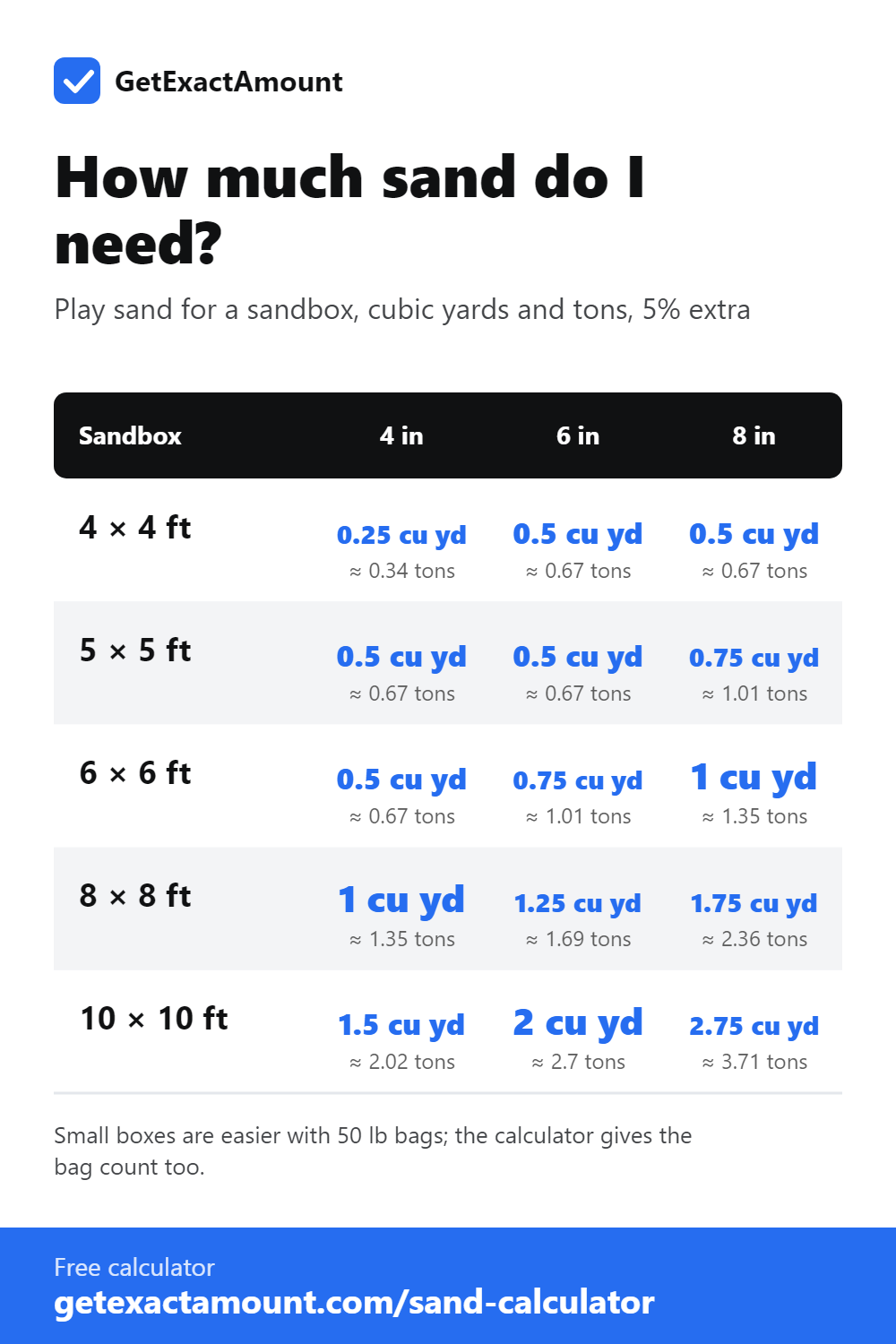
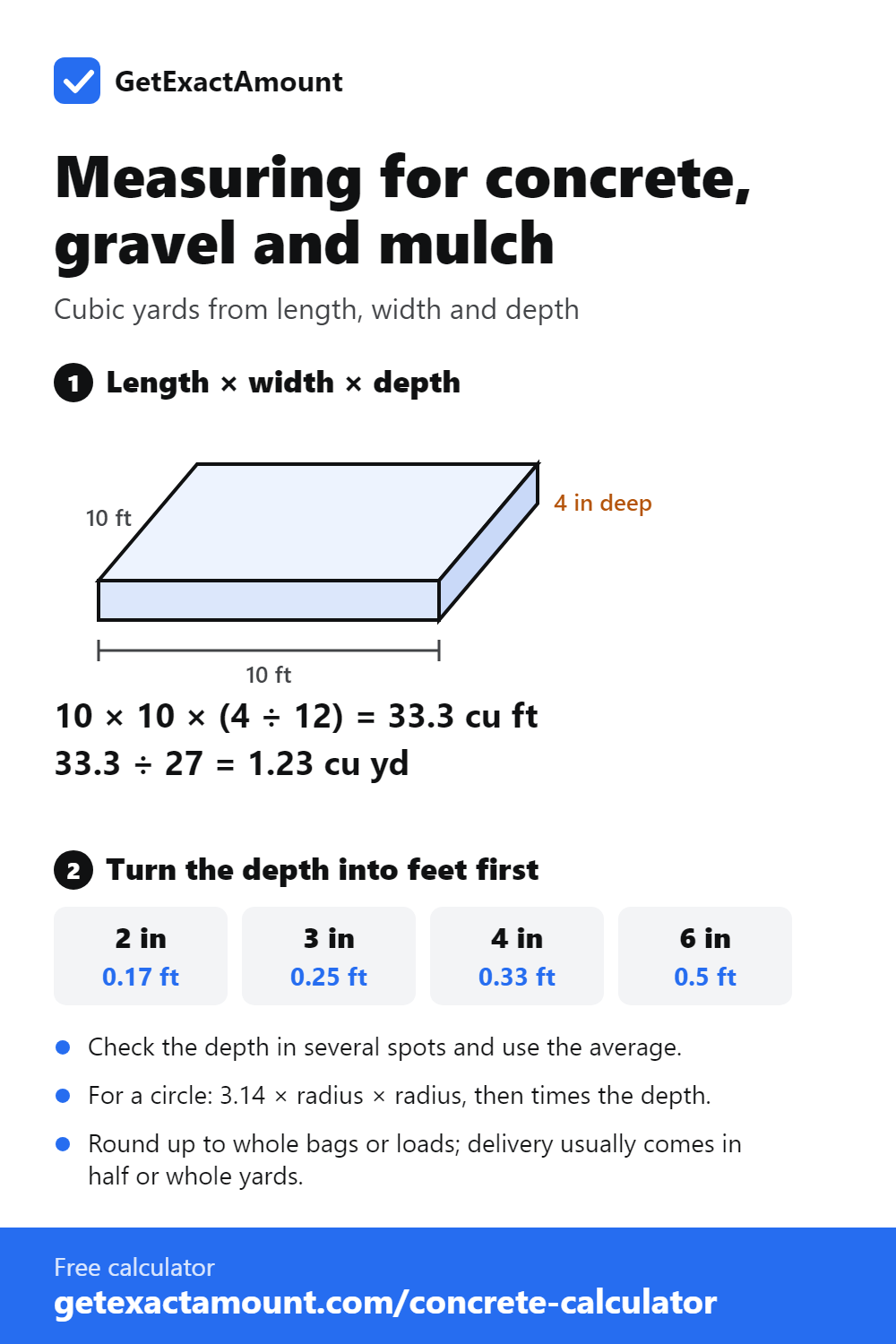
Chart as a table: How much sand do I need?
| Sandbox | 4 in | 6 in | 8 in |
|---|---|---|---|
| 4 × 4 ft | 0.25 cu yd (≈ 0.34 tons) | 0.5 cu yd (≈ 0.67 tons) | 0.5 cu yd (≈ 0.67 tons) |
| 5 × 5 ft | 0.5 cu yd (≈ 0.67 tons) | 0.5 cu yd (≈ 0.67 tons) | 0.75 cu yd (≈ 1.01 tons) |
| 6 × 6 ft | 0.5 cu yd (≈ 0.67 tons) | 0.75 cu yd (≈ 1.01 tons) | 1 cu yd (≈ 1.35 tons) |
| 8 × 8 ft | 1 cu yd (≈ 1.35 tons) | 1.25 cu yd (≈ 1.69 tons) | 1.75 cu yd (≈ 2.36 tons) |
| 10 × 10 ft | 1.5 cu yd (≈ 2.02 tons) | 2 cu yd (≈ 2.7 tons) | 2.75 cu yd (≈ 3.71 tons) |
Which sand do I need?
| Job | Sand | Depth |
|---|---|---|
| Sandbox or sandpit | Washed play sand | 8–12 in (200–300 mm) |
| Under pavers | Coarse concrete sand (sharp sand) | 1 in (25 mm), screeded |
| Leveling under slabs or pools | Leveling or masonry sand | 1–2 in (25–50 mm) |
| Mixing concrete or mortar | Sharp sand or building sand | See the Cement Calculator |
Common mistakes
- Using builders' sand in a sandbox. It stains clothes and can contain silica dust; buy washed play sand.
- Laying a thick sand bed under pavers. Over 1 1/2 in (40 mm) shifts and ruts.
- Ordering bulk sand by weight when it is wet: you get less sand for the same tonnage.
- Leaving a sandbox uncovered. Rain packs it down and animals use it.
What else you'll need
- Landscape fabric under a sandbox so the sand drains but stays clean.
- A sandbox cover or tarp.
- Screed rails and a straight board for leveling sand.
- Gravel for the base under pavers: Gravel Calculator
Frequently asked questions
How much sand do I need for a sandbox?
Length × width × depth. A 6 × 6 ft box filled 8 in deep takes about 24 cu ft, or about 50 bags of 50 lb.
How many bags of sand are in a cubic yard?
About 54 bags of 50 lb, or roughly 1.3 tons of dry sand.
How much does a cubic yard of sand weigh?
About 2,600–3,000 lb when dry, more when wet. We use 2,700 lb (1.6 tonnes per m³).
What sand goes under pavers?
Coarse concrete sand (sharp sand), screeded 1 in (25 mm) deep over a compacted gravel base. Polymeric sand goes in the joints afterwards.
Related calculators
This is an estimate. Actual use depends on the material, the surface, the installation method, waste and site conditions. Check quantities with your supplier before you buy.