Fence Calculator: Posts, Rails, Boards and Panels
Enter the fence length, the post spacing and any gates. We count posts, rails and boards (or panels) and the concrete to set the posts.
Your estimate
Buy 14 posts and 220 boards
36 rails · 35 bags (50 lb fast-setting) of post concrete
- Fence run
- 96 ft1 gate
- Posts
- 1412 sections
- Rails
- 36 × 8 ft
- Boards
- 220 × 5 1/2 in5% extra
- Post concrete
- 1,719 lb · 35 bags (50 lb fast-setting)
Add a price per board to see the cost.
How we got this: 96 ft ÷ 8 ft = 12 sections, 14 posts (one extra per gate). Boards: 96 ft ÷ 5 1/2 in + 5%. Concrete: hole minus post, × 14.
Before you dig, confirm the property line and any permit or HOA rules, and have buried utilities marked (call 811 in the US).
How the calculation works
- Sections. The fence length minus gate openings, divided by the post spacing, rounded up.
- Posts. One more than the number of sections, plus one for each gate.
- Rails and boards. Two or three rails per section; boards are the run divided by board width plus gap, with 5% extra.
- Concrete. Each hole's volume minus the post, times the number of posts, in bags of post mix.
Imperial example: 100 ft of 6 ft privacy fence with one 4 ft gate and posts every 8 ft needs 14 posts, 36 rails, 220 boards of 5 1/2 in and 35 bags of 50 lb fast-setting concrete.
Metric example: 30 m of 1.83 m panels needs 17 panels, 18 posts and 46 bags of 20 kg post mix.
Guides to save and share
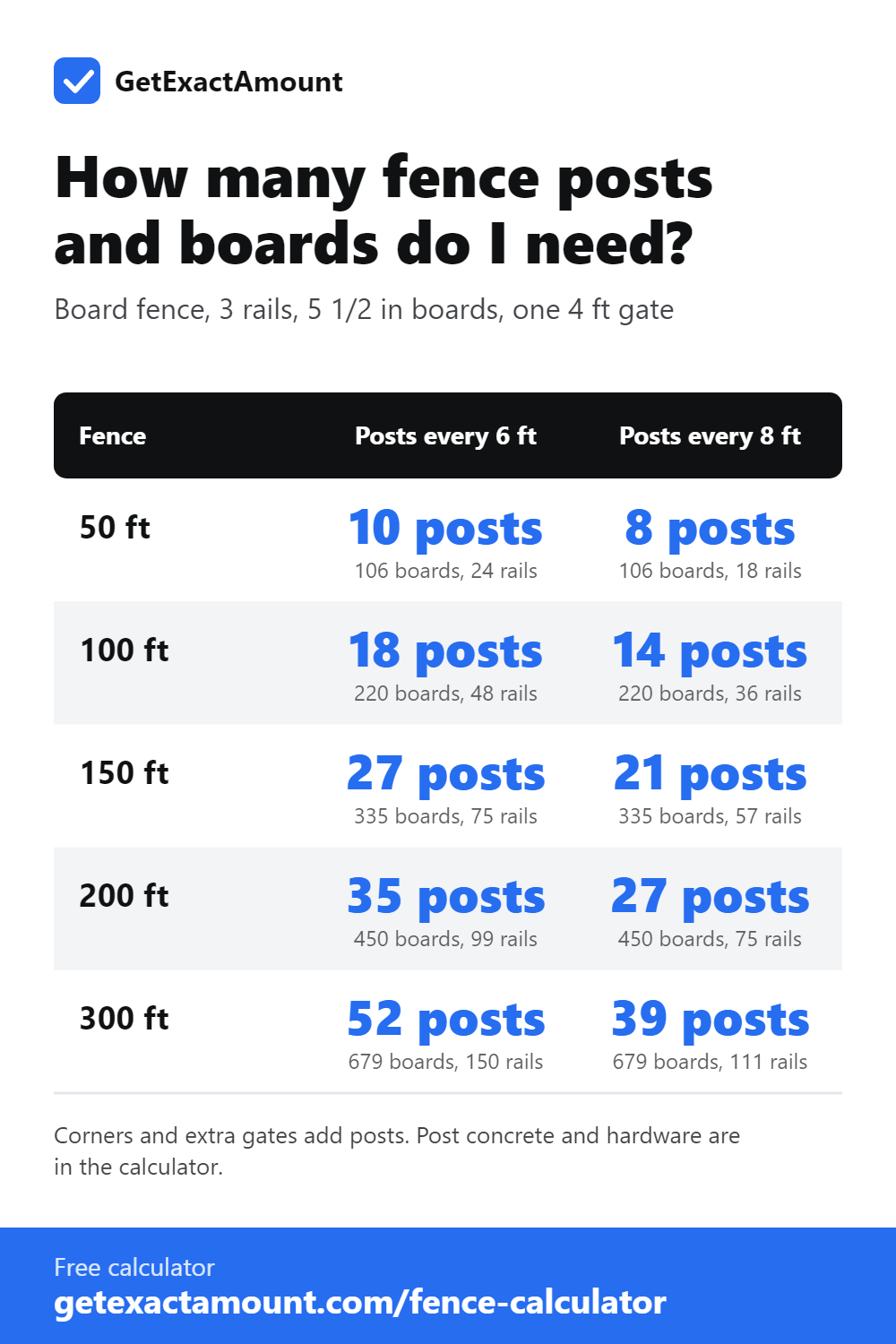
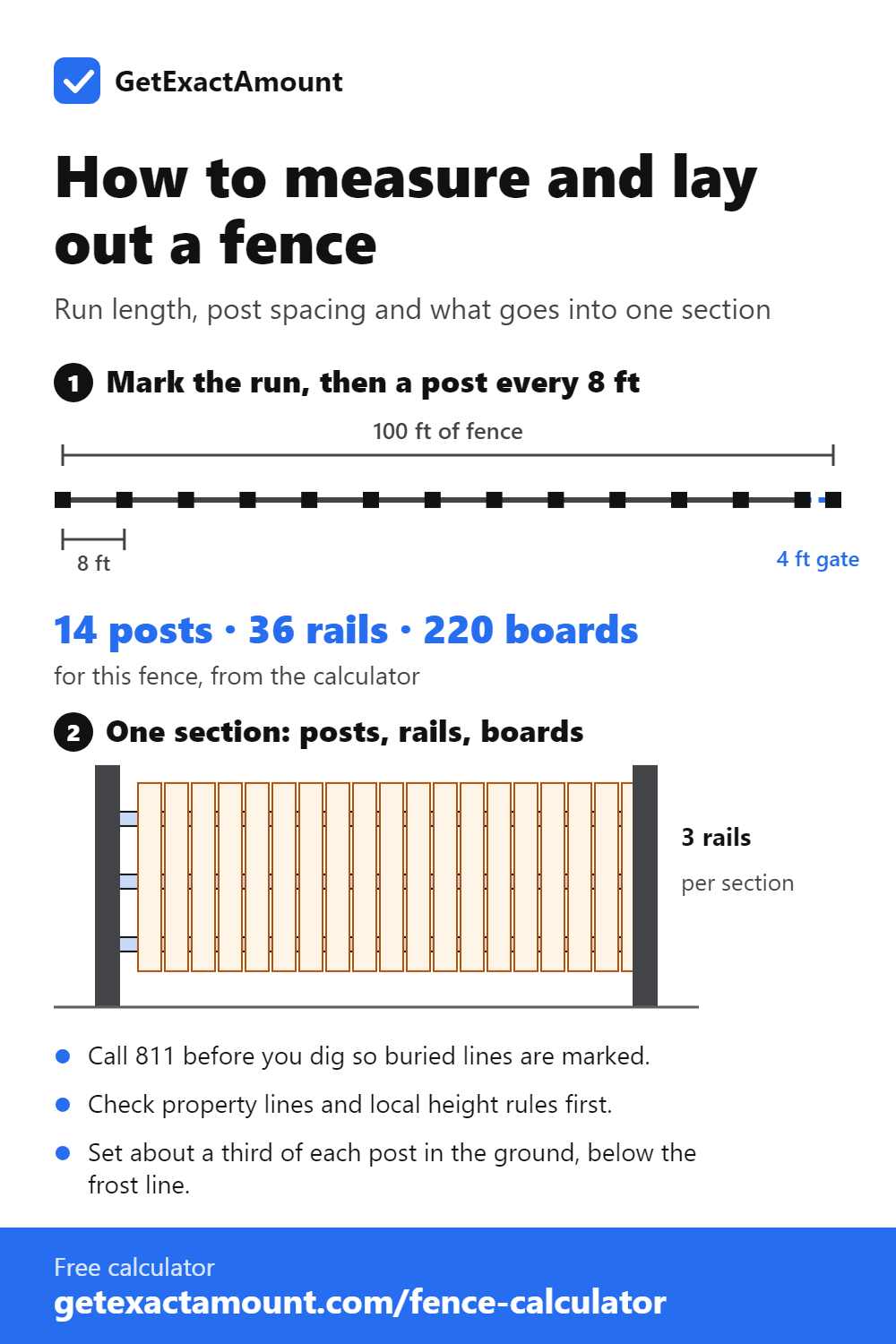
Chart as a table: How many fence posts and boards do I need?
| Fence | Posts every 6 ft | Posts every 8 ft |
|---|---|---|
| 50 ft | 10 posts (106 boards, 24 rails) | 8 posts (106 boards, 18 rails) |
| 100 ft | 18 posts (220 boards, 48 rails) | 14 posts (220 boards, 36 rails) |
| 150 ft | 27 posts (335 boards, 75 rails) | 21 posts (335 boards, 57 rails) |
| 200 ft | 35 posts (450 boards, 99 rails) | 27 posts (450 boards, 75 rails) |
| 300 ft | 52 posts (679 boards, 150 rails) | 39 posts (679 boards, 111 rails) |
How deep should fence posts be?
| Fence height | Hole depth | Hole width |
|---|---|---|
| 3–4 ft (0.9–1.2 m) | 1 1/2–2 ft (0.45–0.6 m) | About 3 times the post width |
| 6 ft (1.8 m) | 2–3 ft (0.6–0.9 m) | 10–12 in (250–300 mm) for 4×4 posts |
| Cold climates | Below the frost line | Check local building guidance |
Common mistakes
- Digging before marking utilities and the property line.
- Spacing posts over 8 ft for board fences: rails sag and boards warp.
- Setting posts in shallow holes. A third of the post above ground should be below it.
- Forgetting the extra post each gate needs, and hinges and a latch.
What else you'll need
- Pressure-treated posts rated for ground contact, and gravel for drainage in each hole.
- Galvanized or stainless nails or screws.
- Gate hinges, a latch and a gate brace.
- A post-hole digger or auger, a level and a string line.
- Concrete for posts: Concrete Calculator
Frequently asked questions
How many fence posts do I need?
Divide the fence length by the post spacing, round up, and add one, plus one for each gate. 100 ft at 8 ft spacing with one gate needs 14 posts.
How far apart should fence posts be?
Usually 6–8 ft (1.8–2.4 m). Ready-made panels set the spacing: 6 ft (1.83 m) in the UK, often 8 ft in the US.
How many bags of concrete per fence post?
For a 10 in hole 2 ft deep around a 4×4 post, about 2–3 bags of 50 lb fast-setting concrete.
How many pickets do I need per foot?
With 5 1/2 in boards and no gap, about 2.2 per foot for a privacy fence. Gaps reduce the count.
Related calculators
This is an estimate. Actual use depends on the material, the surface, the installation method, waste and site conditions. Check quantities with your supplier before you buy.