Plaster Calculator: Bags by Area and Thickness
Enter the area and choose the plaster type to see how many bags to buy. Thickness and coverage follow the type, and you can change them.
Your estimate
Buy 3 bags
3 bags (50 lb) of finish coat
- Area to plaster
- 300 sq ft
- Thickness
- 1/16 in
- Plaster
- 124 lb10% waste
Add a price per bag to see the cost.
How we got this: 300 sq ft × 1/16 in × 6 lb/sq ft per in × 1.10 = 124 lb, rounded up to whole bags.
Check the date on the bags: gypsum plaster goes off after about 4 months and then sets badly.
How the calculation works
- Area. The wall or ceiling area, minus any doors and windows in it (width × height × number).
- Plaster. Area × thickness × how much dry plaster each millimeter takes per square meter: about 1.15 kg for finish plaster, 0.62 kg for a gypsum base coat and 1.8 kg for sand-cement render.
- Bags. We add 10% for uneven walls and plaster that sets in the bucket, then round up to whole bags.
Metric example: 30 m² of finish plaster at 2 mm takes 75.9 kg with waste: 4 bags of 25 kg.
Imperial example: 300 sq ft of gypsum base coat at 3/8 in takes about 181 kg (399 lb) with waste: 8 bags of 50 lb.
Guides to save and share
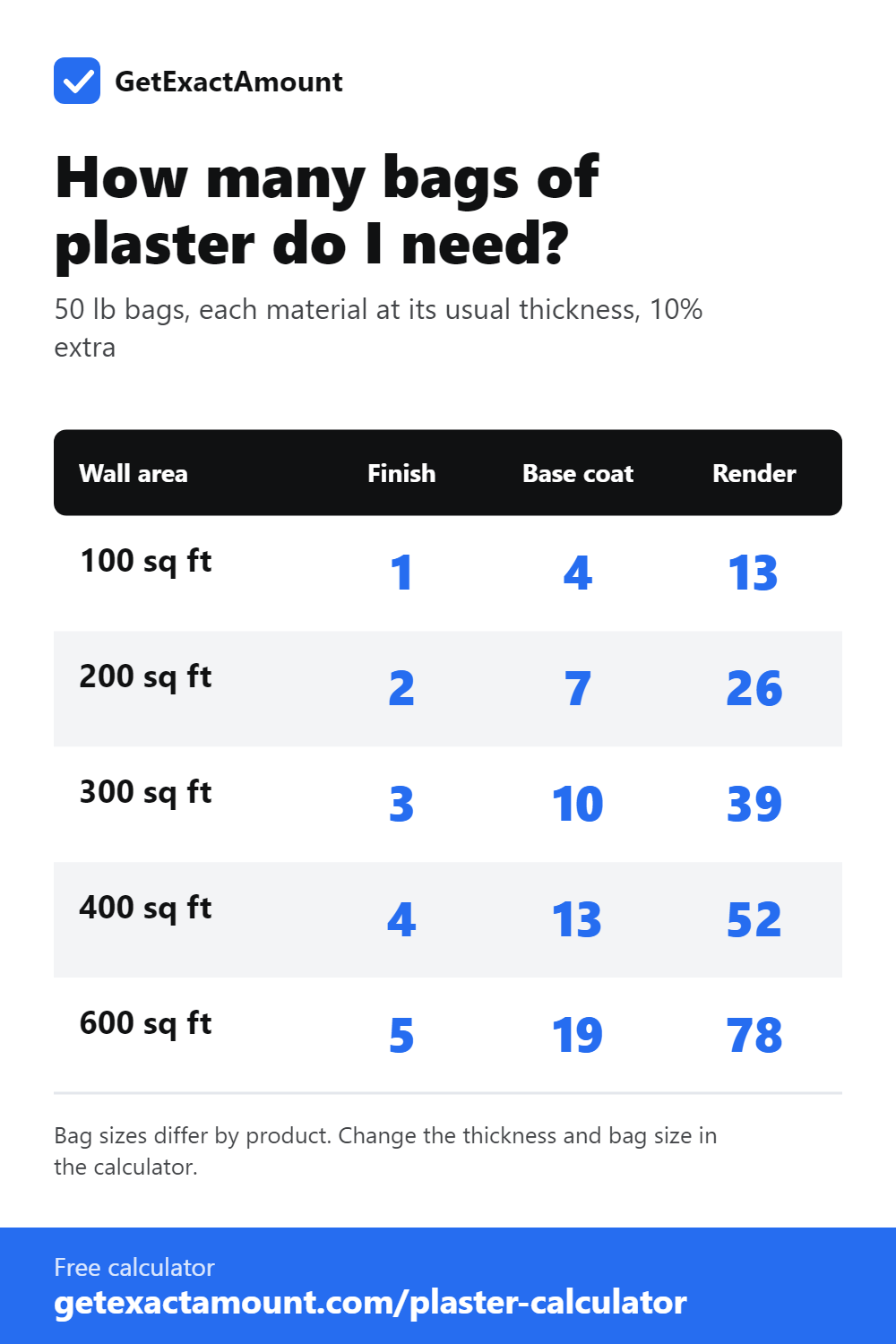
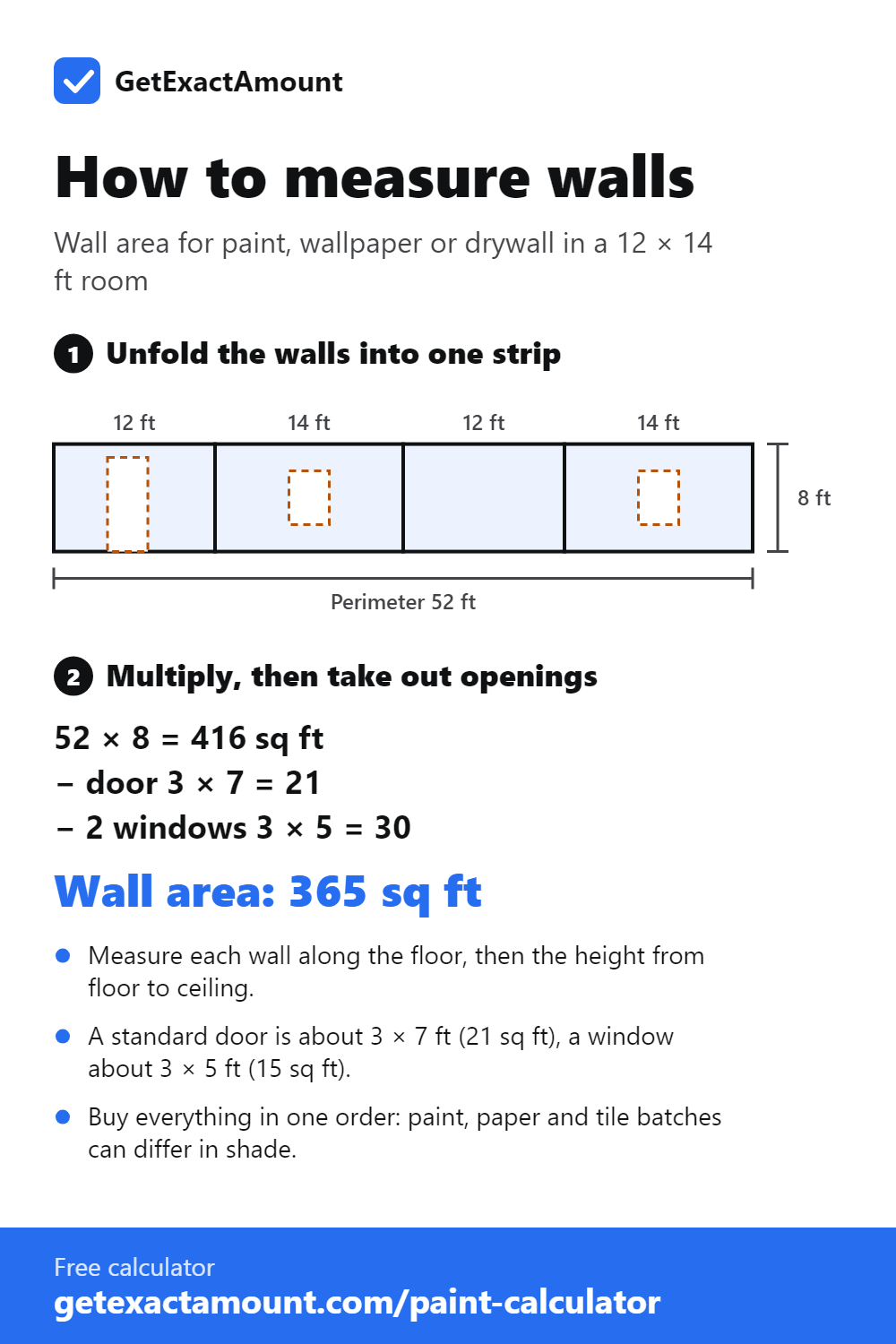
Chart as a table: How many bags of plaster do I need?
| Wall area | Finish | Base coat | Render |
|---|---|---|---|
| 100 sq ft | 1 | 4 | 13 |
| 200 sq ft | 2 | 7 | 26 |
| 300 sq ft | 3 | 10 | 39 |
| 400 sq ft | 4 | 13 | 52 |
| 600 sq ft | 5 | 19 | 78 |
How much waste should I add?
| Walls | Extra | Why |
|---|---|---|
| Flat, previously plastered | 5% | Little variation in thickness. |
| Typical renovation | 10% | Patches, dips and plaster that sets in the bucket. |
| Uneven brick or block | 15% | Low spots fill with extra material. |
Common mistakes
- Using finish plaster to fill deep hollows. Build up with a base coat, then skim.
- Mixing a whole bag at once. Mix only what you can apply in 30–45 minutes.
- Plastering onto smooth or very absorbent walls without a bonding agent or primer.
- Buying old stock. Check the date: gypsum plaster sets badly after about 4 months.
What else you'll need
- A plastering trowel and hawk.
- A mixing paddle, drill and two clean buckets.
- Bonding agent (PVA) or a grit primer.
- Corner beads and scrim tape for board joints.
- A spray bottle and dust sheets.
Frequently asked questions
How much plaster do I need per square metre?
Finish plaster at 2 mm takes about 2.3 kg per m². A gypsum base coat at 11 mm takes about 7 kg per m², and sand-cement render at 15 mm about 27 kg per m².
How many square metres does a 25 kg bag of plaster cover?
About 10–11 m² of finish plaster at 2 mm, or about 3.5 m² of gypsum base coat at 11 mm. The bag lists the coverage for that product.
How thick should plaster be?
Finish plaster goes on in two thin coats, 2–3 mm in total. Base coats are usually 8–13 mm, and render 15–20 mm, applied in coats.
Base coat or finish coat: which do I need?
Use a base coat on bare brick or block, or to fill uneven walls. Use only a finish coat (skim) over plasterboard or walls that are already flat.
How long does plaster take to dry before painting?
A thin finish coat usually needs 1–2 weeks, depending on the weather and ventilation. It turns an even light color when dry. Seal new plaster with a mist coat before painting.
Related calculators
This is an estimate. Actual use depends on the material, the surface, the installation method, waste and site conditions. Check quantities with your supplier before you buy.