Joint Compound Calculator: Mud, Tape and Corner Bead
Enter the drywall area and the finish level. We work out the compound (drywall mud), the joint tape and the corner bead for your outside corners.
Your estimate
Buy 2 containers
1 × 4.5 gal box + 1 × 1 gal of joint compound
- Drywall area
- 500 sq ftLevel 4
- Compound
- 5.5 gal10% waste
- Joint tape
- 185 ft · 1 roll (250 ft roll)
- Corner bead
- 4 × 8 ft
Add a price per container to see the cost.
How we got this: 500 sq ft × 0.108 gal per sq ft (Level 4) × 1.10 = 5.5 gal.
Use setting-type compound (hot mud) for the tape coat and deep fills, and lightweight ready-mixed compound for the final coats: it sands much more easily.
How the calculation works
- Compound. About 1 gallon of ready-mixed compound per 100 sq ft of drywall for a Level 4 finish (tape coat plus two finishing coats). Level 3 uses about a quarter less; Level 5 adds a skim coat over the whole surface, about half as much again.
- Tape. About 370 ft of joint tape per 1,000 sq ft of drywall.
- Corner bead. One piece per outside corner for each length of wall height.
Imperial example: 500 sq ft at Level 4 plus 10% is 5.5 gallons: a 4.5-gallon box and a 1-gallon pail, a 250 ft roll of tape and four 8 ft pieces of corner bead.
Metric example: 46 m² at Level 4 plus 10% is 20.6 L: three 10 L tubs and a 90 m roll of tape.
Guides to save and share
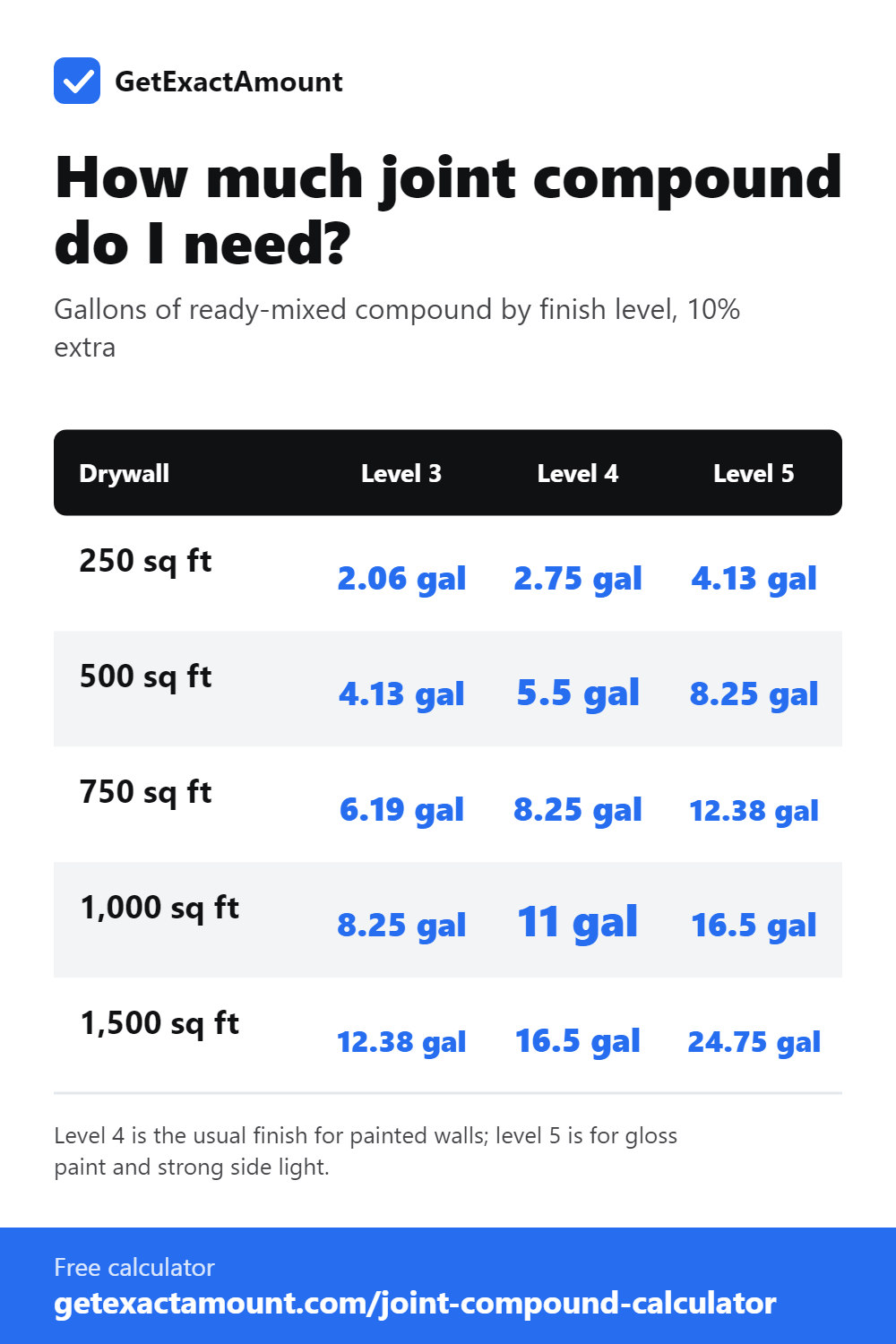
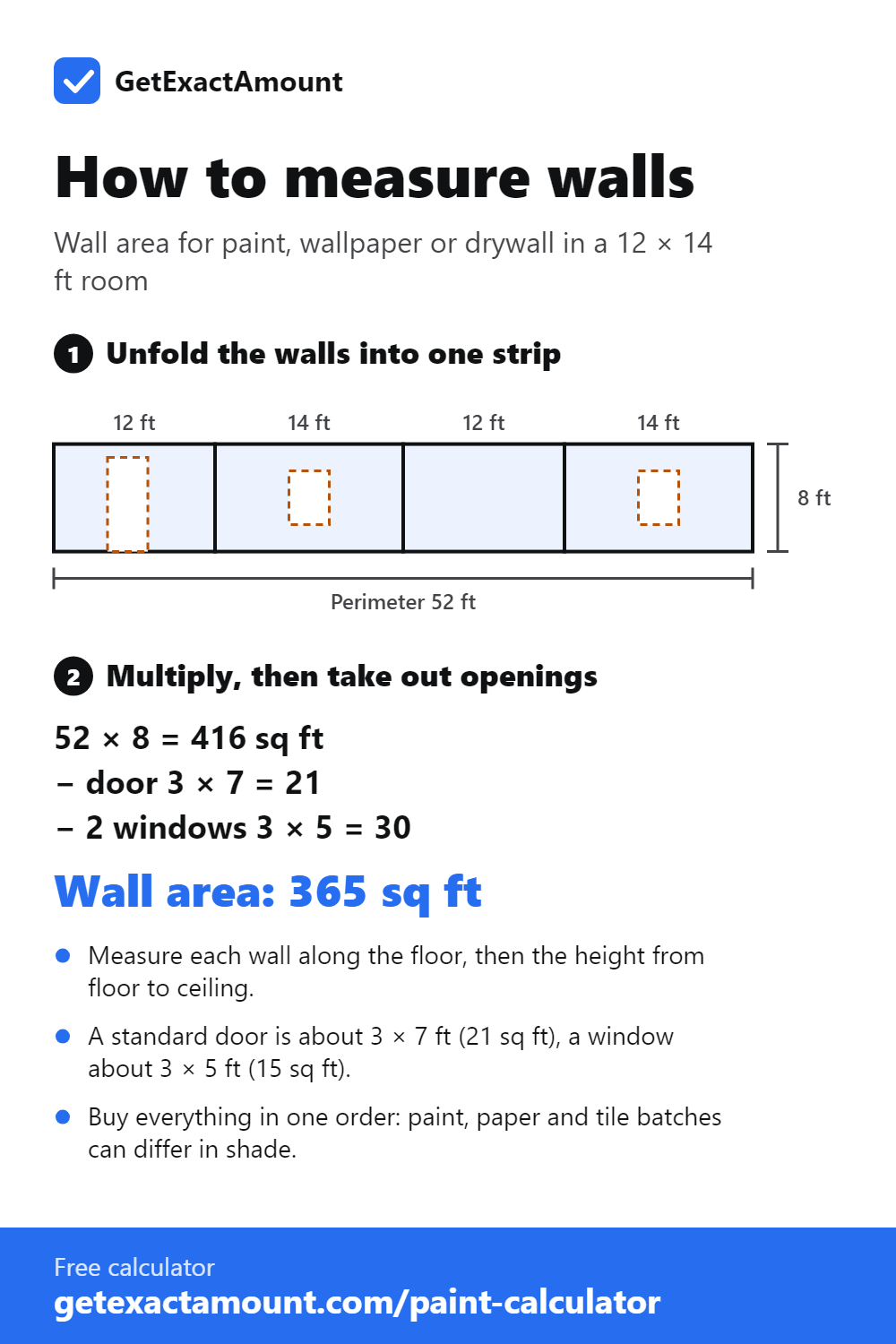
Chart as a table: How much joint compound do I need?
| Drywall | Level 3 | Level 4 | Level 5 |
|---|---|---|---|
| 250 sq ft | 2.06 gal | 2.75 gal | 4.13 gal |
| 500 sq ft | 4.13 gal | 5.5 gal | 8.25 gal |
| 750 sq ft | 6.19 gal | 8.25 gal | 12.38 gal |
| 1,000 sq ft | 8.25 gal | 11 gal | 16.5 gal |
| 1,500 sq ft | 12.38 gal | 16.5 gal | 24.75 gal |
Which finish level do I need?
| Level | What it is | Use it for |
|---|---|---|
| Level 3 | Tape coat and one more coat on joints and screws | Walls under heavy texture or tile |
| Level 4 | Tape coat and two more coats | Most painted walls with flat or eggshell paint |
| Level 5 | Level 4 plus a thin skim coat over everything | Gloss paint, dark colors, strong side light |
Common mistakes
- Using lightweight compound for the tape coat. It bonds less well; all-purpose or setting-type compound holds tape better.
- Applying thick coats to finish faster. Thick mud cracks and shrinks; three thin coats beat two thick ones.
- Sanding through to the paper tape. Feather wide instead of sanding hard.
- Skipping primer. Bare compound absorbs paint differently from the paper face.
What else you'll need
- Paper or mesh joint tape and metal or paper-faced corner bead.
- Taping knives (6, 10 and 12 in) and a mud pan or hawk.
- A mixing paddle for powder compound.
- A sanding sponge or pole sander, and a dust mask.
- Drywall primer before painting.
Frequently asked questions
How much joint compound do I need per sheet of drywall?
For a Level 4 finish, about a third of a gallon per 4 × 8 ft sheet, or 1 gallon per 100 sq ft.
How many coats of mud does drywall need?
Three for a Level 4 finish: a tape coat, a fill coat and a finish coat, each wider than the last.
Ready-mixed or powder compound?
Ready-mixed is easiest for most jobs. Setting-type powder (hot mud) hardens chemically, so it is good for the tape coat, deep fills and cold rooms.
Paper or mesh tape?
Paper tape is stronger in corners and with all-purpose compound. Mesh tape is self-adhesive and faster on flat joints, but use setting-type compound over it.
What is a Level 5 drywall finish?
A Level 4 finish with a thin skim coat over the whole surface, so the paper and compound absorb paint evenly. It is recommended under gloss paint or strong side light.
Related calculators
This is an estimate. Actual use depends on the material, the surface, the installation method, waste and site conditions. Check quantities with your supplier before you buy.